Sprinkler Pipe Size Chart: How Many Sprinklers per Pipe Size (NFPA 13)
How many sprinklers can a 1 inch pipe feed? What size pipe do you need for 2 sprinklers, 10 sprinklers or a whole floor? This guide gives the complete sprinkler pipe size chart from the NFPA 13 pipe schedule method, shows how to size a branch line and cross main step by step, and explains when the table is allowed and when you need a hydraulic calculation instead.
Quick answer
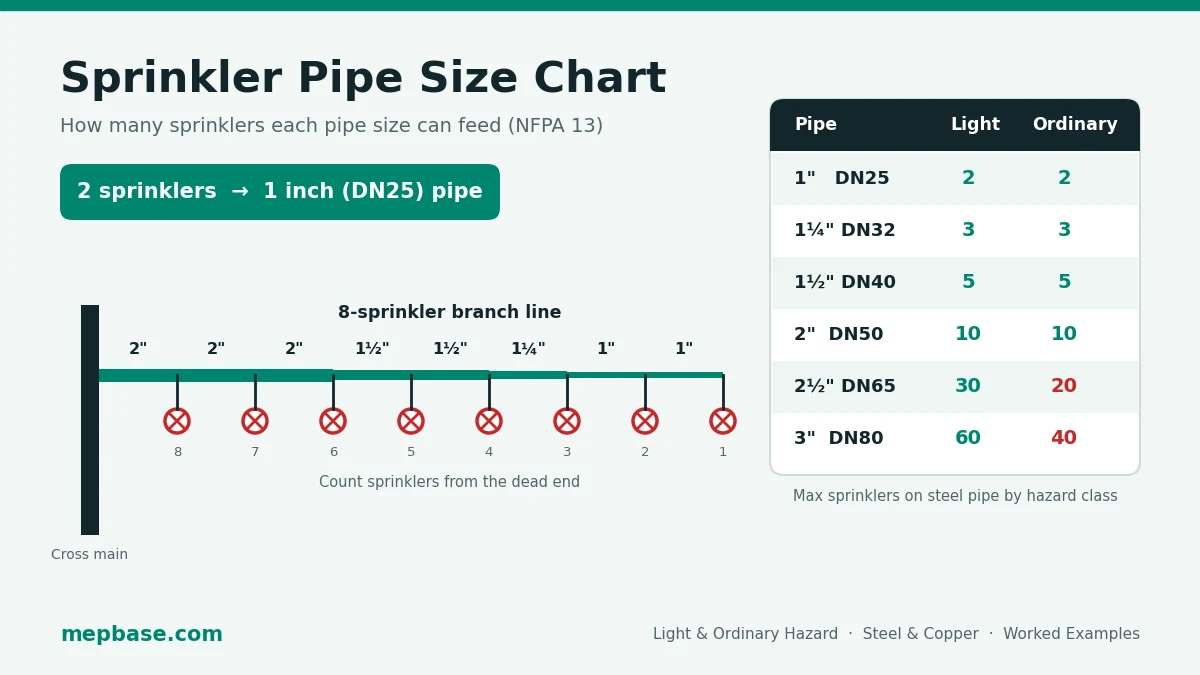
2 sprinklers need a 1 inch (DN25) pipe in both light and ordinary hazard. 1¼ inch takes 3 sprinklers, 1½ inch takes 5 and 2 inch takes 10 in steel pipe. Above 2 inch the limit depends on the hazard class.
Key takeaways
- Count the sprinklers downstream of each pipe, starting from the dead end.
- Up to 2 inch, light and ordinary hazard use the same limits.
- From 2½ inch upwards ordinary hazard allows fewer sprinklers per pipe.
- The pipe schedule is only for light and ordinary hazard, mostly small systems. Larger new systems need a hydraulic calculation.
In this guide
Sprinkler Pipe Size Chart (NFPA 13 Pipe Schedule)
The pipe schedule method sizes each pipe by counting how many sprinklers are downstream of it. Every pipe must be at least the size the table gives for that number of sprinklers.
Light Hazard
Offices, schools, hospitals, hotels, residential areas, restaurant seating areas, churches.
| Pipe size | Metric | Max sprinklers, steel | Max sprinklers, copper |
|---|---|---|---|
| 1 in | DN25 | 2 | 2 |
| 1¼ in | DN32 | 3 | 3 |
| 1½ in | DN40 | 5 | 5 |
| 2 in | DN50 | 10 | 12 |
| 2½ in | DN65 | 30 | 40 |
| 3 in | DN80 | 60 | 65 |
| 3½ in | DN90 | 100 | 115 |
| 4 in and larger | DN100+ | Limited by the maximum floor area per system | — |
Ordinary Hazard (Group 1 and Group 2)
Car parks, laundries, restaurant kitchens, mechanical rooms, retail shops, workshops, light storage.
| Pipe size | Metric | Max sprinklers, steel | Max sprinklers, copper |
|---|---|---|---|
| 1 in | DN25 | 2 | 2 |
| 1¼ in | DN32 | 3 | 3 |
| 1½ in | DN40 | 5 | 5 |
| 2 in | DN50 | 10 | 12 |
| 2½ in | DN65 | 20 | 25 |
| 3 in | DN80 | 40 | 45 |
| 3½ in | DN90 | 65 | 75 |
| 4 in | DN100 | 100 | 115 |
| 5 in | DN125 | 160 | 180 |
| 6 in | DN150 | 275 | 300 |
Watch out
Pipe Size for Any Number of Sprinklers
Turned around, the table gives the minimum steel pipe size for any number of sprinklers:
| Sprinklers fed | Light hazard | Ordinary hazard |
|---|---|---|
| 1–2 | 1 in (DN25) | 1 in (DN25) |
| 3 | 1¼ in (DN32) | 1¼ in (DN32) |
| 4–5 | 1½ in (DN40) | 1½ in (DN40) |
| 6–10 | 2 in (DN50) | 2 in (DN50) |
| 11–20 | 2½ in (DN65) | 2½ in (DN65) |
| 21–30 | 2½ in (DN65) | 3 in (DN80) |
| 31–40 | 3 in (DN80) | 3 in (DN80) |
| 41–60 | 3 in (DN80) | 3½ in (DN90) |
| 61–65 | 3½ in (DN90) | 3½ in (DN90) |
| 66–100 | 3½ in (DN90) | 4 in (DN100) |
Site tip
Why 2 Sprinklers Need a 1 Inch Pipe
The table is not arbitrary. Take two standard K5.6 sprinklers flowing at 10 psi:
Q = 2 × 17.7 = 35.4 gpm (134 L/min)
In 1 inch Schedule 40 steel (internal diameter 1.049 in, C = 120) the Hazen-Williams formula gives:
velocity ≈ 13 ft/s (4.0 m/s)
That is fine over the short run at the end of a branch line. Add a third sprinkler to the same 1 inch pipe and the flow rises to 53 gpm: friction more than doubles to about 0.79 psi per ft and velocity reaches nearly 20 ft/s. That is why the third sprinkler moves the pipe up to 1¼ inch. Check any pipe this way with the Fire Hydraulic Calculator, and get sprinkler flow from pressure with the Sprinkler K-Factor Calculator.
Worked Example 1: Branch Line with 8 Sprinklers
Number the sprinklers 1 to 8 from the far end of the branch line back towards the cross main.
Each pipe segment carries every sprinkler beyond it, so the segment before sprinkler 3 carries 3.
Use the column for your hazard class and pipe material.
| Pipe segment | Sprinklers downstream | Pipe size |
|---|---|---|
| End sprinkler to sprinkler 2 | 1 | 1 in |
| Sprinkler 2 to 3 | 2 | 1 in |
| Sprinkler 3 to 4 | 3 | 1¼ in |
| Sprinkler 4 to 5 | 4 | 1½ in |
| Sprinkler 5 to 6 | 5 | 1½ in |
| Sprinkler 6 to 7 | 6 | 2 in |
| Sprinkler 7 to 8 | 7 | 2 in |
| Sprinkler 8 to cross main | 8 | 2 in |
A full 8-sprinkler branch line therefore runs 1″ – 1″ – 1¼” – 1½” – 1½” – 2″ – 2″ – 2″, the same in light and ordinary hazard. The pipe schedule limits a branch line to 8 sprinklers on each side of the cross main, with only small exceptions in NFPA 13.
Worked Example 2: Cross Main with 48 Sprinklers
Six branch lines of 8 sprinklers each are fed from one cross main. Count from the far end again:
| Cross main segment | Sprinklers downstream | Light hazard | Ordinary hazard |
|---|---|---|---|
| After 1st branch line | 8 | 2 in | 2 in |
| After 2nd branch line | 16 | 2½ in | 2½ in |
| After 3rd branch line | 24 | 2½ in | 3 in |
| After 4th branch line | 32 | 3 in | 3 in |
| After 5th branch line | 40 | 3 in | 3 in |
| Feed main (all 6 lines) | 48 | 3 in | 3½ in (or 4 in) |
The same 48 sprinklers need a 3 inch feed in an office but 3½ or 4 inch in a car park. This is exactly where using the wrong hazard table fails an inspection.
Coverage Area per Sprinkler
The pipe schedule assumes standard spray sprinklers at normal spacing, so it also limits the area each sprinkler may cover:
| Hazard | Max area per sprinkler | Max spacing |
|---|---|---|
| Light hazard | 200 ft² (18.6 m²) with pipe schedule; 225 ft² (20.9 m²) if hydraulically calculated | 15 ft (4.6 m) |
| Ordinary hazard | 130 ft² (12.1 m²) | 15 ft (4.6 m) |
Maximum distance to a wall is half the spacing, 7.5 ft (2.3 m).
Check a layout against these limits and the design density with the Sprinkler Density Calculator.
When Can You Use the Pipe Schedule Method?
The pipe schedule is simple, but NFPA 13 now restricts it. Use it only when all of these apply:
Extra hazard and storage always need a hydraulic calculation.
A new system of 5,000 ft² (465 m²) or less, or an addition or change to an existing pipe schedule system. Larger new systems qualify only where the supply gives the required flow at 50 psi residual or more at the highest sprinkler.
Including hose streams, roughly 500–750 gpm at 15 psi residual for light hazard and 850–1,500 gpm at 20 psi for ordinary hazard, for the required duration.
Many civil defence authorities in the Gulf ask for hydraulic calculations on every new project, so check before you submit.
For everything else, size the pipes by hydraulic calculation. The method is explained in the fire fighting system design calculation guide, with the full background in the fire fighting system complete course.
Sprinklers Above and Below a Ceiling
Where the same branch lines feed sprinklers both above and below a ceiling, for example in a combustible ceiling void, NFPA 13 has a separate table that allows more sprinklers on the smaller pipe sizes, and a branch line may carry up to 8 sprinklers above and 8 below. Do not use the standard tables above for these lines; take the values from the NFPA 13 edition your authority has adopted.
Common Mistakes
A kitchen, car park or plant room inside an office building is ordinary hazard. From 2½ inch upwards its pipes follow the ordinary hazard table.
Always count the sprinklers downstream of the pipe, starting from the dead end of the branch line.
The higher copper numbers apply only to copper tube. CPVC follows its own listing.
Steel sprinkler pipe must be at least 1 inch. Copper tube may go down to ¾ inch, but only in hydraulically calculated systems.
A large new building almost always needs a hydraulic design, even if the pipe sizes end up similar.
Size it properly in minutes
Check flow, friction loss and pressure at every sprinkler instead of relying on the table alone.
Frequently Asked Questions
What size pipe do I need for 2 sprinklers?
A 1 inch (DN25) pipe. Under the NFPA 13 pipe schedule a 1 inch steel or copper pipe can feed a maximum of 2 sprinklers in both light hazard and ordinary hazard.
How many sprinklers can a 1 inch pipe supply?
Two. A third sprinkler needs 1¼ inch pipe, four or five need 1½ inch, and six to ten need 2 inch steel pipe.
How many sprinklers can a 2 inch pipe supply?
Ten in steel pipe and twelve in copper tube, in both light and ordinary hazard.
How many sprinklers on a 3 inch pipe?
In steel pipe, 60 in light hazard but only 40 in ordinary hazard. Copper allows 65 and 45.
Is the pipe schedule method still allowed?
Yes, but only for light and ordinary hazard, mainly for new systems up to 5,000 ft² and for changes to existing pipe schedule systems. Most new projects are designed by hydraulic calculation, and many authorities require it.
How many sprinklers can be on one branch line?
Eight on each side of the cross main under the pipe schedule method, with only limited exceptions in NFPA 13. Hydraulically calculated systems have no fixed count but must meet pressure and flow at every sprinkler.
Free Resources
- Fire sprinkler distribution AutoLISP
- Fire fighting threaded fittings CAD blocks
- Black steel pipe dynamic block
- Basement fire fighting shop drawing
- Pipe Schedule Reference (dimensions and wall thickness)
References
- NFPA 13, Standard for the Installation of Sprinkler Systems: pipe schedule method, light hazard and ordinary hazard pipe schedules
- NFPA 13: water supply requirements for pipe schedule systems
- Hazen-Williams friction loss formula as used in NFPA 13 hydraulic calculations