FM-200 Calculation: Agent Quantity Formula Step by Step (NFPA 2001)
Clean agent systems protect rooms where water would do more damage than the fire: server rooms, control rooms, archives and telecom spaces. Getting the agent quantity right matters in both directions: too little and the fire is not extinguished, too much and the concentration can exceed the safe limit for people in the room. This guide walks through FM-200 calculation step by step to NFPA 2001: net volume, design concentration, the flooding factor formula, temperature and altitude corrections, the occupant safety check and cylinder selection, with a full worked example for a server room.
How an FM-200 system works
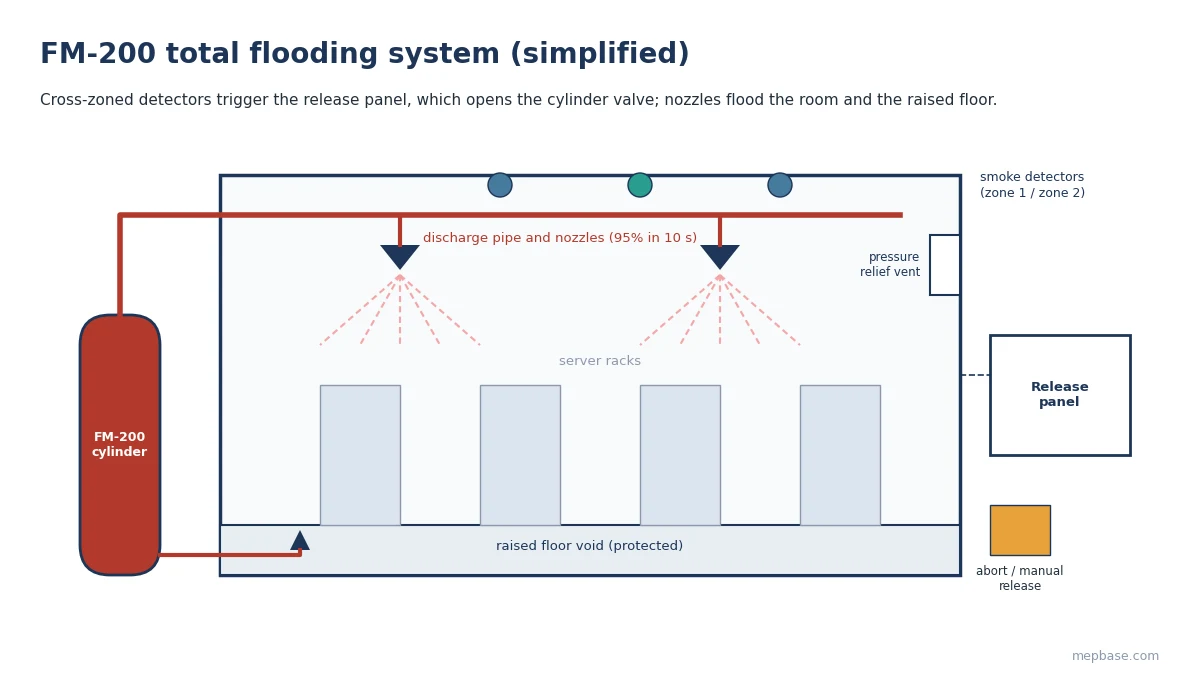
FM-200 (HFC-227ea) is a total flooding clean agent. Smoke detectors on two cross-zoned circuits signal a release panel, which sounds the alarms, runs a short pre-discharge delay and then opens the cylinder valve. The agent discharges through nozzles in under 10 seconds and must hold the extinguishing concentration in the room long enough for the fire to go out, normally at least 10 minutes.
Step 1: Find the net protected volume
Calculate the volume of every space that will be flooded together: the room, plus any raised floor void and ceiling void that are open to it or protected at the same time. Deduct only permanent, impermeable objects such as structural columns or solid cabinets. Server racks and furniture are usually not deducted.
Openings that cannot be closed before discharge (unclosable doors, ventilation that does not shut down) add agent loss and must be addressed in the design. Enclosure integrity is confirmed with a door fan test after construction.
Step 2: Select the design concentration
NFPA 2001 sets the minimum design concentration as the agent’s extinguishing concentration for the fuel, multiplied by a safety factor:
| Hazard | Safety factor on extinguishing concentration | Typical FM-200 design |
|---|---|---|
| Class A surface fires (paper, plastics) | 1.2 | about 6.7–7.0% |
| Class B flammable liquids | 1.3 | about 8.5–9%, depending on the fuel |
| Class C energized electrical equipment | 1.35 | about 7.0% |
Use the concentrations from the system’s UL or FM listing for the specific hazard; the values above are typical. Most data centre and electrical room designs use about 7% FM-200.
Step 3: Calculate the flooding factor
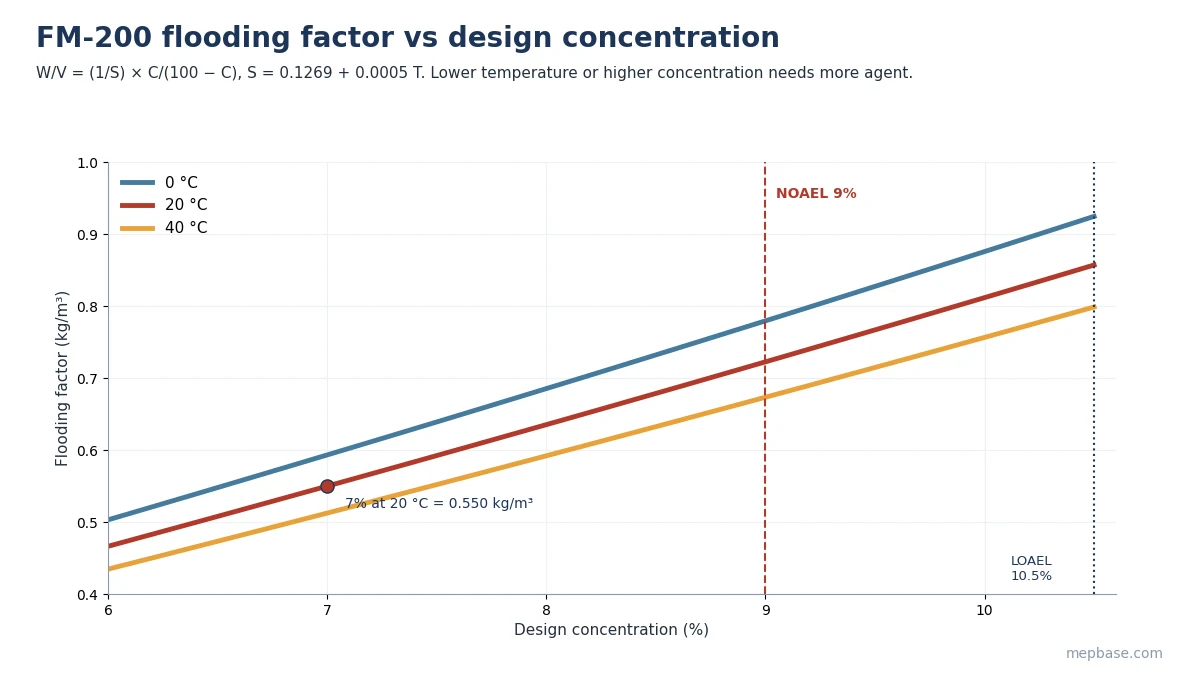
W = (V / S) × C / (100 − C)
S = 0.1269 + 0.0005 × T (m³/kg, T in °C)
- W = mass of FM-200 (kg)
- V = net protected volume (m³)
- C = design concentration (% by volume)
- S = specific vapour volume of HFC-227ea at the minimum expected room temperature
Using the lowest temperature is conservative, because colder air holds more agent per cubic metre. At 7% and 20 °C, the flooding factor is 0.550 kg/m³.
Step 4: Apply the altitude correction
Air is less dense at altitude, so less agent is needed to reach the same concentration. NFPA 2001 gives an atmospheric correction factor: about 0.96 at 300 m, 0.93 at 600 m (Riyadh) and 0.89 at 900 m. Multiply W by the factor. Sites below sea level need more agent.
Step 5: Check the concentration for occupied spaces
The concentration rises when the room is warmer than the design temperature, so check it at the maximum expected temperature:
Cmax = 100 × X / (1 + X), where X = W × Smax / V
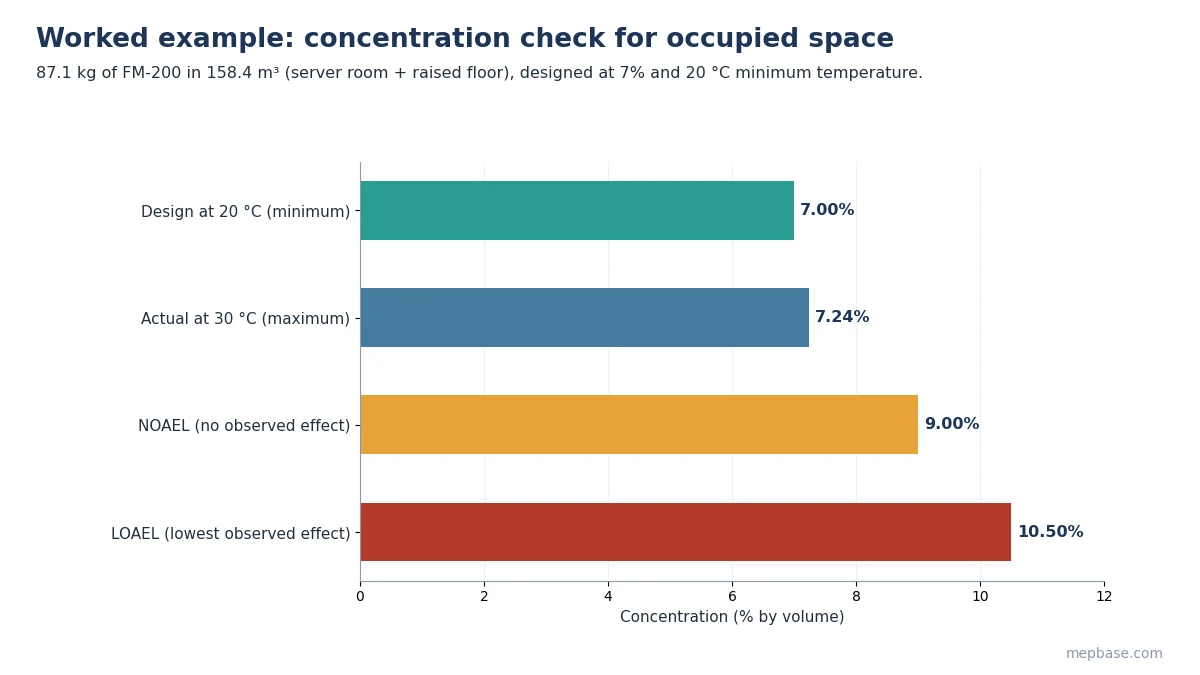
For HFC-227ea the NOAEL (no observed adverse effect level) is 9.0% and the LOAEL is 10.5%. In normally occupied spaces, keep the maximum concentration at or below the NOAEL; between NOAEL and LOAEL, NFPA 2001 limits exposure time and requires prompt egress.
Step 6: Select cylinders and check discharge
- Divide the agent mass by the cylinder fill to get the number of containers. FM-200 containers are filled up to about 1.15 kg per litre of container volume.
- Discharge must deliver 95% of the agent within 10 seconds; the supplier’s flow calculation sets the pipe sizes and nozzle orifices.
- Provide pressure relief venting sized by the supplier, because the discharge briefly changes the room pressure.
- Most designs need a hold time of at least 10 minutes, verified by the door fan test.
FM-200 calculation: worked example for a server room
A server room is 8 × 6 × 3 m with a 0.3 m raised floor, both protected. The room is in Riyadh (about 610 m), with a minimum temperature of 20 °C and a maximum of 30 °C. Design concentration is 7% for Class C equipment.
| Step | Calculation | Result |
|---|---|---|
| Room volume | 8 × 6 × 3 | 144.0 m³ |
| Raised floor volume | 8 × 6 × 0.3 | 14.4 m³ |
| Net volume V | no deductions | 158.4 m³ |
| S at 20 °C | 0.1269 + 0.0005 × 20 | 0.1369 m³/kg |
| Agent at sea level | (158.4 / 0.1369) × 7 / 93 | 87.1 kg |
| Agent at 610 m | 87.1 × 0.93 | 81.0 kg |
| S at 30 °C | 0.1269 + 0.0005 × 30 | 0.1419 m³/kg |
| Concentration at 30 °C | X = 87.1 × 0.1419 / 158.4 = 0.0780 | 7.24% (below 9% NOAEL ✓) |
| Cylinders | one container of about 106 L (up to about 121 kg) | 1 cylinder |
Run your own room in the FM200 Calculator, which also covers Novec 1230 and CO₂, and size the releasing panel’s standby battery with Fire Alarm Battery Calculation.
Common mistakes
- Calculating at 20 °C when the room can be colder, which under-sizes the agent.
- Forgetting the raised floor or ceiling void that is open to the room.
- Not checking the maximum concentration at the highest room temperature against the NOAEL.
- Ignoring altitude: at 600 m the agent quantity is about 7% lower; below sea level it is higher.
- Skipping the door fan test, so unsealed openings let the agent leak out before the hold time.
For complete detection and release drawings, see the Deluge Foam-Water Sprinkler System DWG (release panel, cross-zoned detection and mounting details) and Fire Alarm AutoCAD Blocks.
Frequently asked questions
What is the FM-200 calculation formula?
W = (V / S) × C / (100 − C), where W is the agent mass in kg, V the net volume in m³, C the design concentration in percent and S = 0.1269 + 0.0005 × T, with T the minimum room temperature in °C.
How much FM-200 is needed per cubic metre?
0.550 kg/m³ at 7% and 20 °C. At 8% it is 0.635 kg/m³. Multiply by the net volume and by the altitude correction factor.
What design concentration is used for FM-200?
About 7% for data centres, electrical and Class A hazards, and 8.5–9% for flammable liquids. Use the value from the system listing for the actual hazard.
Is FM-200 safe for people?
Yes at normal design concentrations. The NOAEL is 9.0% and the LOAEL is 10.5%, so a 7% design leaves a margin even when the room warms up.
How long must FM-200 discharge take?
95% of the agent must discharge within 10 seconds, and the room must then hold the concentration, typically for at least 10 minutes.