Cable Size Calculation: From Load to Cable Size (Formula + Example)
Choosing the right cable size is one of the most important steps in any electrical design. Undersize it and the cable overheats, wastes energy, and becomes a fire risk; oversize it and you waste money. This guide shows you exactly how to go from the load to the correct cable size — with the formulas, the design checks, and a complete worked example.
What Decides Cable Size?
A cable is never sized on current alone. The final size is the largest size that satisfies every one of these factors:
- Design (load) current — how much current the circuit will actually carry
- Protective device rating — the breaker or fuse protecting the circuit
- Derating factors — ambient temperature, grouping, and installation method
- Current-carrying capacity (ampacity) — the rated current of the chosen cable
- Voltage drop — must stay within the allowed limit over the run length
- Conductor material and insulation — copper vs aluminium, PVC vs XLPE
- Short-circuit / earth-fault withstand — for protection coordination
The Cable Sizing Formulas
1. Design (Load) Current
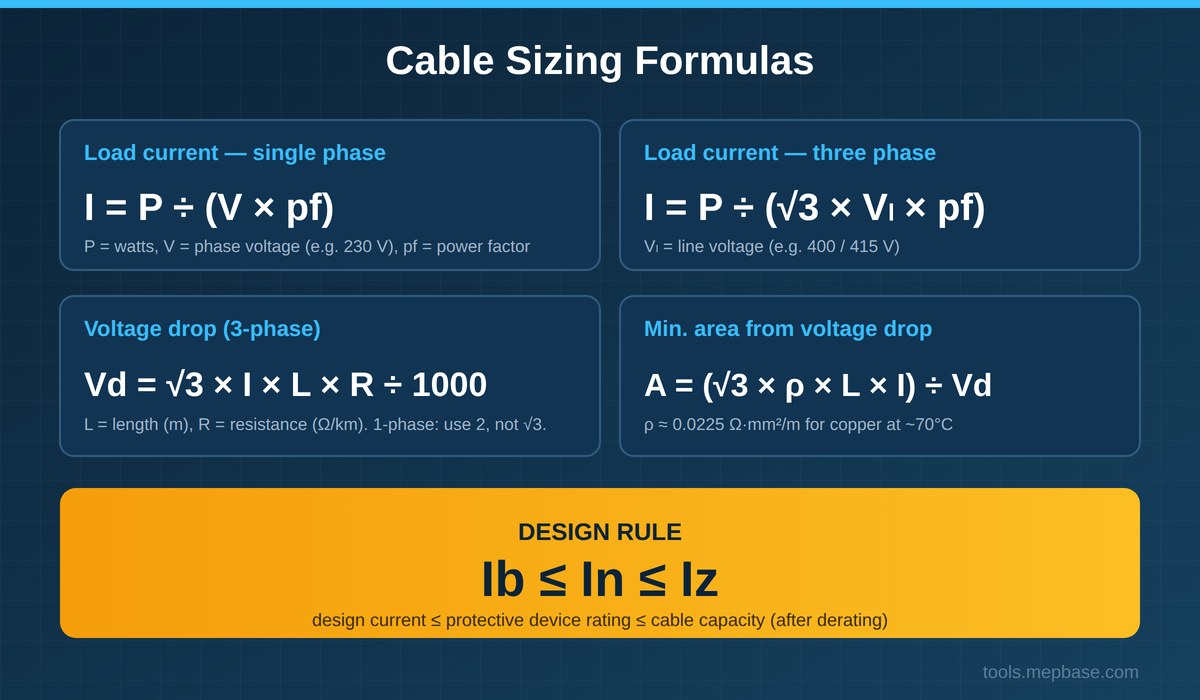
Single phase: I = P ÷ (V × pf)
Three phase: I = P ÷ (√3 × VL × pf)
Where P is power in watts, V is the phase voltage (e.g. 230 V) or VL the line voltage (e.g. 400/415 V), and pf is the power factor. For motors, also divide by the efficiency (η).
2. Voltage Drop
Three phase: Vd = √3 × I × L × R ÷ 1000
Single phase: Vd = 2 × I × L × R ÷ 1000
Where L is the length in metres and R is the cable resistance in Ω/km. As a percentage: %Vd = (Vd ÷ V) × 100.
3. Minimum Area from Voltage Drop
If voltage drop governs, find the minimum conductor area directly:
A = (√3 × ρ × L × I) ÷ Vdallowed (three phase)
Where ρ ≈ 0.0225 Ω·mm²/m for copper at operating temperature (use ≈ 0.036 for aluminium).
The Golden Design Rule
Every cable must satisfy:
Ib ≤ In ≤ Iz
That is: the design current (Ib) ≤ the protective device rating (In) ≤ the cable’s effective capacity (Iz) after derating.
How to Calculate Cable Size: Step-by-Step
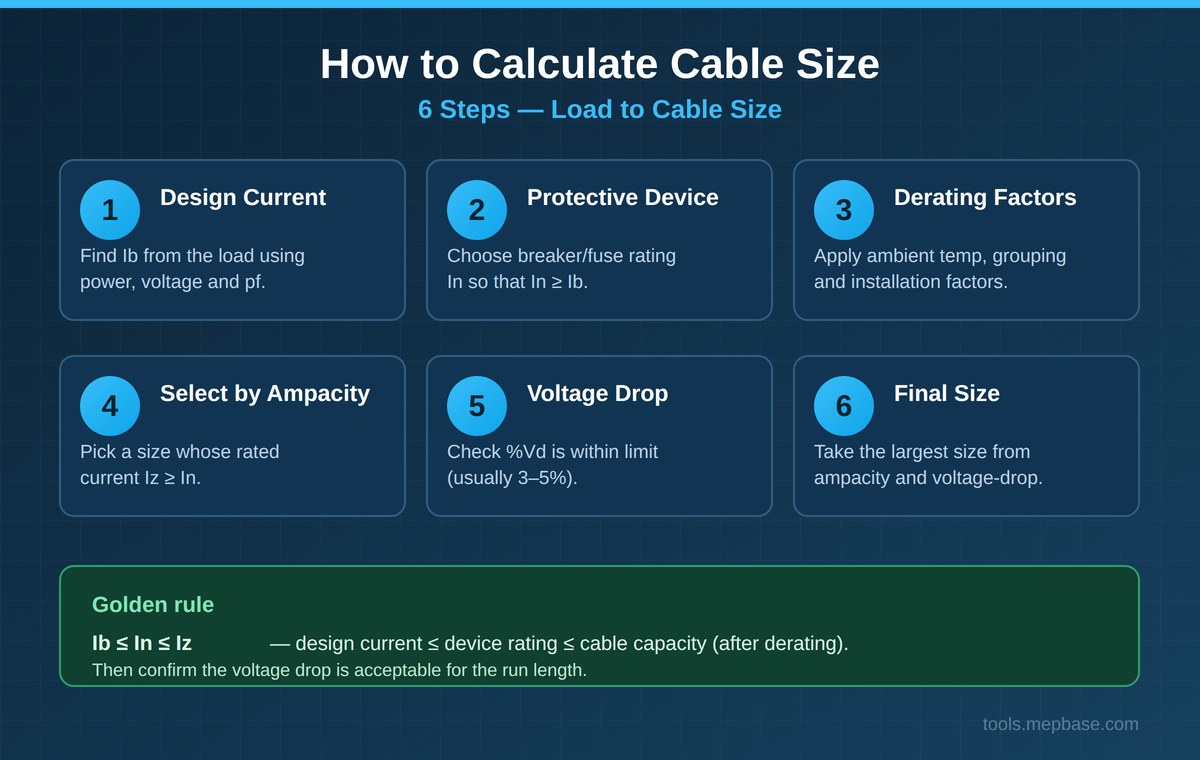
- Calculate the design current (Ib) from the load using the formulas above.
- Select the protective device (In) so that In ≥ Ib (e.g. the next standard breaker rating).
- Apply derating factors — ambient temperature (Ca), grouping (Cg), and installation method. The required tabulated rating is It ≥ In ÷ (Ca × Cg × …).
- Select the cable size from the manufacturer’s or standard ampacity tables so its rated current meets the requirement.
- Check the voltage drop over the actual run length; if it exceeds the limit, increase the size.
- Take the largest size from the ampacity check and the voltage-drop check — that’s your final cable.
Worked Example
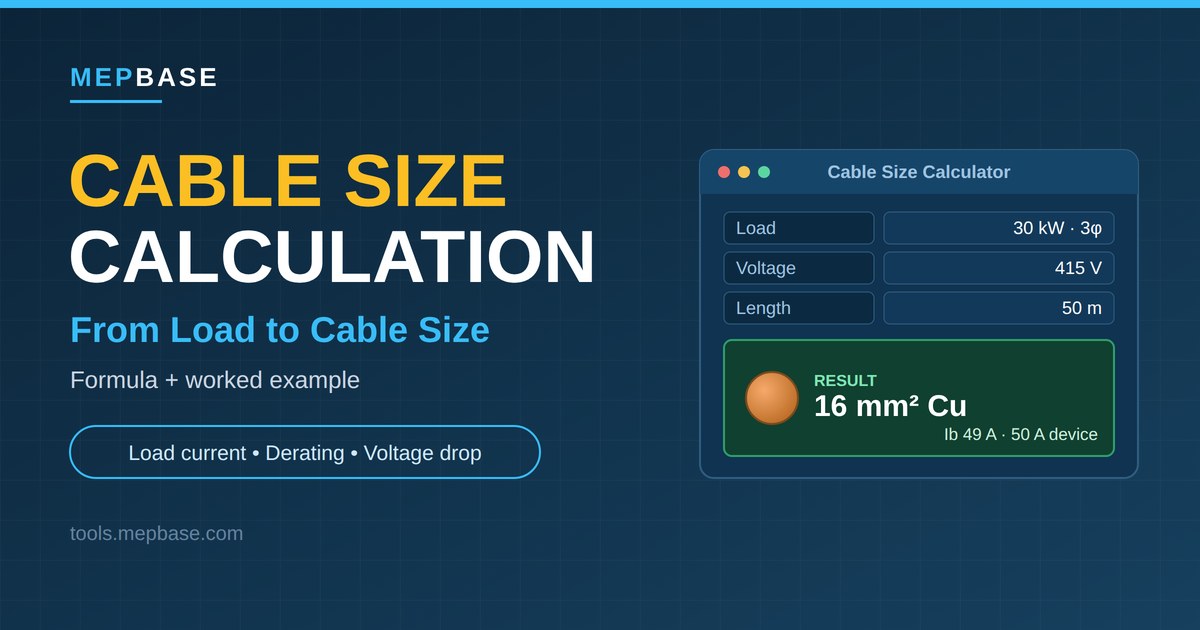
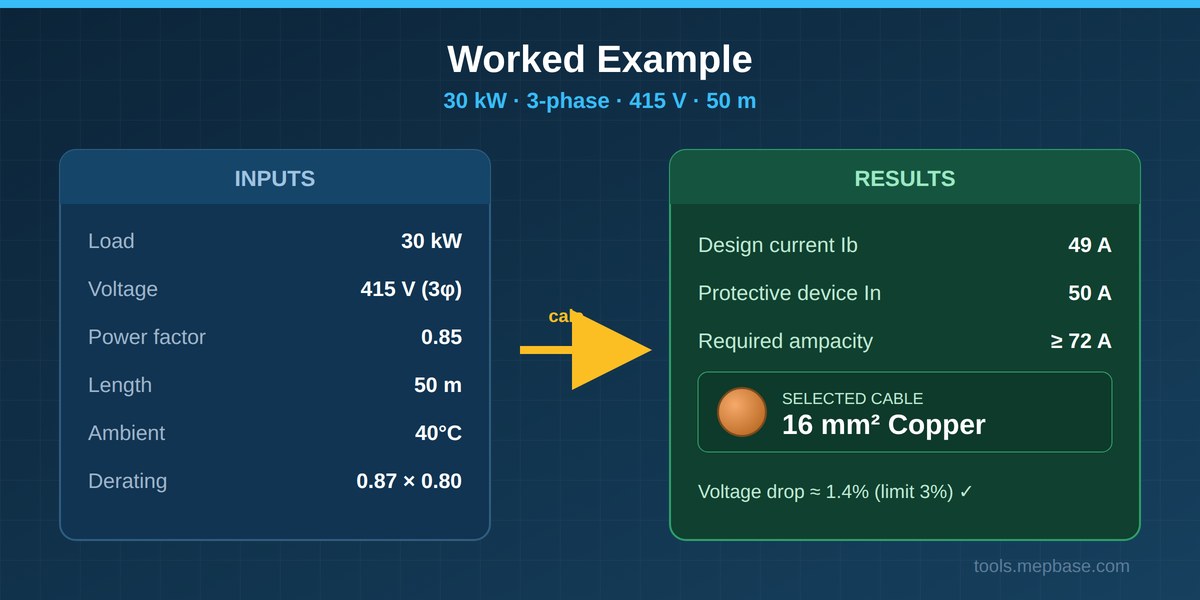
Let’s size the cable for a 30 kW, three-phase, 415 V load with a power factor of 0.85, a run length of 50 m, installed at 40 °C ambient and grouped with other circuits. The voltage-drop limit is 3 %.
Step 1 — Design current:
I = 30000 ÷ (√3 × 415 × 0.85) = 30000 ÷ 611 ≈ 49 A. So Ib ≈ 49 A.
Step 2 — Protective device:
Choose In = 50 A (next standard rating), satisfying Ib ≤ In (49 ≤ 50).
Step 3 — Derating:
For a 70 °C PVC cable at 40 °C, Ca ≈ 0.87; grouped with others, Cg ≈ 0.80. Combined factor = 0.87 × 0.80 = 0.696.
Required tabulated rating It ≥ 50 ÷ 0.696 ≈ 72 A.
Step 4 — Select cable:
A 16 mm² copper cable has a tabulated rating of roughly 76 A, which exceeds 72 A. So its derated capacity Iz ≈ 76 × 0.696 ≈ 53 A, comfortably above both In (50 A) and Ib (49 A).
Step 5 — Voltage drop check (16 mm² Cu):
Using R ≈ 1.38 Ω/km at operating temperature:
Vd = √3 × 49 × 50 × 1.38 ÷ 1000 ≈ 5.9 V → %Vd = 5.9 ÷ 415 × 100 ≈ 1.4 %, well within the 3 % limit.
Step 6 — Final size: Both checks pass, so the cable is 16 mm² copper, protected by a 50 A device.
Note that on the voltage-drop check alone, a smaller 10 mm² cable would have been enough — but ampacity governs here, which is why we always take the larger result. You can verify any of these numbers instantly with the free MEPBase Electrical Cable Size Calculator.
Typical Voltage Drop Limits
Limits depend on your local code, but common values are:
- Lighting circuits: around 3 %
- Power circuits: around 5 %
- Total (supply origin to final point): often capped at 4–5 %
Always confirm the exact figure required by the standard you design to (IEC, BS 7671, NEC, or local regulations).
Copper vs Aluminium
Copper has lower resistivity, higher ampacity for the same size, and is easier to terminate — ideal for smaller circuits and tight spaces. Aluminium is lighter and cheaper, so it’s common on large feeders and long runs, but it needs about one or two sizes larger than copper for the same current and requires proper terminations. Choose based on cost, run length, and space.
Common Cable Sizing Mistakes
- Forgetting derating factors — a cable in a hot, crowded conduit carries far less than its tabulated rating.
- Ignoring voltage drop on long runs — ampacity may pass while voltage drop fails.
- Sizing on the breaker only without checking the actual load current.
- Mixing units — keep length, resistivity, and current consistent.
- Overlooking protective device coordination (Ib ≤ In ≤ Iz, and I2 ≤ 1.45 × Iz).
Frequently Asked Questions
How do I calculate cable size from load?
Find the design current from the load, choose a protective device of equal or higher rating, apply derating factors, select a cable whose rated current meets the requirement, and finally confirm the voltage drop is within limits.
What is the formula for three-phase cable current?
I = P ÷ (√3 × VL × pf), where P is power in watts, VL is the line voltage, and pf is the power factor.
What voltage drop is acceptable?
Commonly around 3 % for lighting and 5 % for power, but always follow your local code.
Should I use copper or aluminium cable?
Copper for smaller circuits and tight spaces; aluminium for large feeders and long runs where weight and cost matter. Aluminium needs a larger size for the same current.
Is there an online cable size calculator?
Yes — the MEPBase Electrical Cable Size Calculator does the full calculation (current, derating, and voltage drop) in your browser.
Conclusion
Cable sizing always follows the same logic: find the load current, protect it, derate the cable, check the ampacity, and confirm the voltage drop — then take the largest size. Keep the rule Ib ≤ In ≤ Iz in mind and you’ll size cables safely every time.
Want a fast, accurate result without the manual maths? Try the free MEPBase Electrical Cable Size Calculator.
This guide is for general educational purposes. Always design to your applicable electrical code (IEC, BS 7671, NEC, or local regulations) and have designs verified by a qualified engineer.