Boiler Feed Pump Calculation: Flow, Head & Motor Power
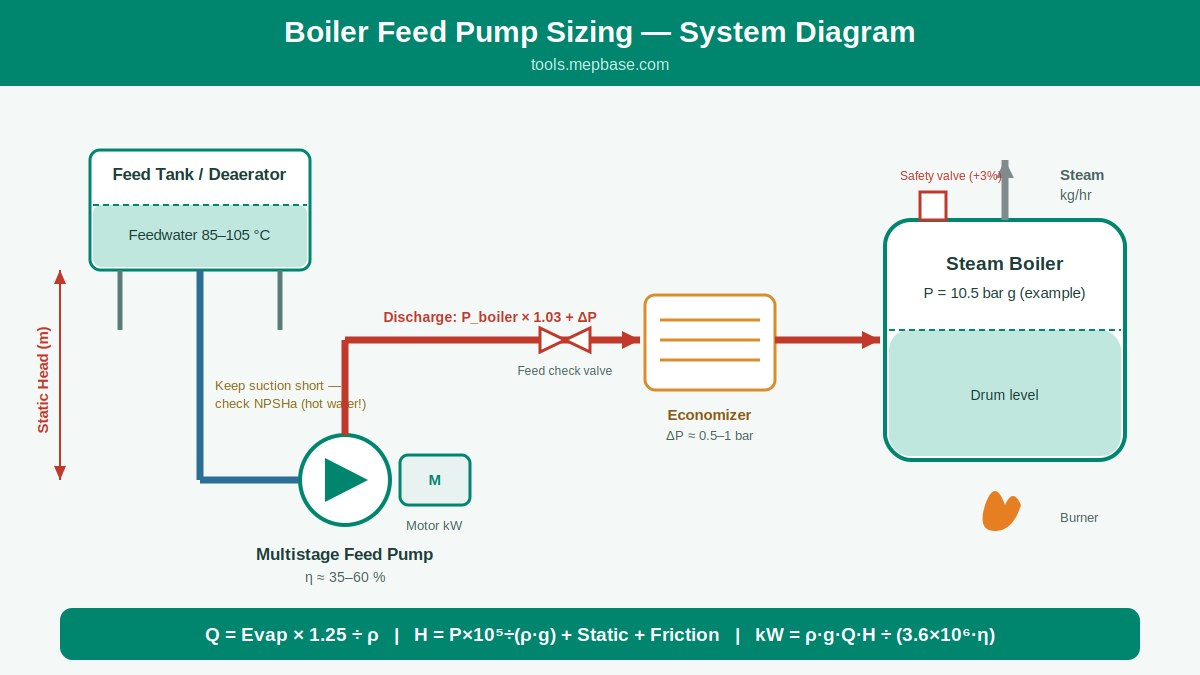
Sizing a boiler feed pump looks simple on paper — until an undersized pump can’t hold drum level on a live boiler, or an oversized one runs throttled and cavitating for years. In this guide you’ll learn the complete boiler feed pump calculation step by step: feedwater flow rate, total pump head, and motor power — with formulas, a worked example, and a quick-reference sizing table used by practicing MEP engineers.
💡 Short on time? Use our free Boiler Feed Pump Calculator — enter boiler capacity and pressure, get flow, head and motor kW instantly.
What Is a Boiler Feed Pump?
A boiler feed pump (also called a feed water pump or BFW pump) delivers treated water from the feed tank or deaerator into a steam boiler against the boiler’s operating pressure. Because it must overcome full boiler pressure plus system losses, it is a high-head, moderate-flow duty — which is why multistage centrifugal pumps are the industry standard for this application.
Correct sizing matters more here than in almost any other pump application. Codes such as the Indian Boiler Regulations (IBR Reg. 623) and EN 12953-6 legally require the feed apparatus to deliver more water than the boiler can evaporate at peak — because losing drum level on a fired boiler is a genuine safety event, not just an inconvenience.
Boiler Feed Pump Calculation — 3 Steps
Step 1: Feedwater Flow Rate
The pump must supply more than the boiler’s maximum evaporation to cover blowdown losses, on/off or modulating feed control, and safety-valve lift conditions. Standard practice is a 15–25% margin:
Q (kg/hr) = Boiler Evaporation × (1 + Margin%)

Q (m³/hr) = Q (kg/hr) ÷ ρ

where ρ = water density at feedwater temperature (kg/m³)
Don’t skip the density correction. Feedwater from a deaerator at 85–105 °C has a density of roughly 955–970 kg/m³, not 1000 — about a 3–4% difference in volumetric flow.
Step 2: Discharge Pressure and Total Head
The pump discharge pressure must cover the boiler working pressure plus safety-valve accumulation (typically 3%), plus the pressure drop across the economizer and feed check valve:
Pdis = Pboiler × (1 + SV margin%) + ΔPeconomizer + valves
Then convert pressure to head and add the static lift and pipe friction:
H (m) = Pdis × 10⁵ ÷ (ρ × 9.81) + Static Head + Friction Losses
Rule of thumb: 1 bar ≈ 10.2 m of water head with cold water. With hot feedwater the lower density pushes this to ~10.6–10.7 m per bar — another reason the temperature correction matters.
Step 3: Pump Power and Motor Selection
Phydraulic (kW) = ρ × g × Q × H ÷ (3.6 × 10⁶)

Pshaft = Phydraulic ÷ ηpump

Motor kW = next standard IEC rating ≥ Pshaft × (1 + service factor)
Multistage feed pumps typically run at 35–60% efficiency at feed-pump duty points — far below the 70–80% you may be used to from HVAC pumps. Always check the manufacturer’s curve. A 10–20% motor service factor over shaft power is normal practice.
Worked Example: 5 TPH Boiler at 10.5 bar g
Let’s size a feed pump for a 5,000 kg/hr boiler at 10.5 bar g with 85 °C feedwater, 25% flow margin, 3% pressure margin, 1 bar economizer/valve drop, 5 m static head and 5 m friction loss:
- Flow: 5,000 × 1.25 = 6,250 kg/hr → at ρ = 968.6 kg/m³ → 6.45 m³/hr
- Discharge pressure: 10.5 × 1.03 + 1.0 = 11.8 bar g
- Head: 11.8 × 10⁵ ÷ (968.6 × 9.81) = 124.2 m, + 5 + 5 = ≈ 134 m
- Power: hydraulic ≈ 2.3 kW → at 45% efficiency, shaft ≈ 5.1 kW → with 15% margin ≈ 5.9 kW → select a 7.5 kW (10 HP) motor
You can verify these exact numbers in seconds with the online boiler feed pump calculator — it applies the density correction and IEC motor selection automatically.
Quick Reference: Feed Pump Sizes for Common Boilers
| Boiler Capacity | Pump Flow (1.25×) | Indicative Motor @ 10 bar g |
|---|---|---|
| 1,000 kg/hr (1 TPH) | ~1.3 m³/hr | 2.2 kW |
| 2,000 kg/hr (2 TPH) | ~2.6 m³/hr | 3.7–4 kW |
| 5,000 kg/hr (5 TPH) | ~6.5 m³/hr | 7.5 kW |
| 10,000 kg/hr (10 TPH) | ~13 m³/hr | 15 kW |
| 20,000 kg/hr (20 TPH) | ~26 m³/hr | 30 kW |
Indicative values at 85 °C feedwater and ~45% pump efficiency — always verify against vendor curves.
5 Design Tips Engineers Learn the Hard Way
1. NPSH is the #1 failure point. Feedwater at 85–105 °C sits close to its vapor pressure — any dip in suction pressure flashes it to steam and the pump cavitates. Elevate the deaerator or feed tank 3–8 m above the pump centerline, keep suction piping short and one size larger than the pump suction nozzle, and ensure NPSHavailable exceeds NPSHrequired by at least 0.5–1 m.
2. Provide standby capacity. IBR and most international codes require two feed apparatus — the standard arrangement is 2 × 100% pumps (one duty, one standby).
3. Check the safety-valve condition. With on/off feed control, the pump must still deliver water when the boiler is sitting at safety-valve set pressure — that’s the real design point, not normal working pressure.
4. Protect against minimum flow. Multistage pumps overheat quickly at low or zero flow. Provide a recirculation line or leak-off orifice back to the feed tank.
5. Verify with the vendor curve. Hand calculations and calculators give a preliminary duty point. Final selection must match a manufacturer’s tested performance curve (Grundfos CR, KSB Movitec, Wilo MVI, Kirloskar and similar ranges).
Frequently Asked Questions
How do you calculate boiler feed pump capacity?
Multiply the boiler’s maximum evaporation rate by 1.15–1.25, then divide by water density at feedwater temperature to convert kg/hr to m³/hr. The margin covers blowdown, feed-control cycling and safety-valve lift.
How much head does a boiler feed pump need?
Boiler working pressure plus ~3% safety-valve accumulation, plus economizer and feed-valve pressure drops — converted to metres of water (≈10.2–10.7 m per bar depending on temperature) — plus static lift and pipe friction.
Why is the feed pump sized at 1.25 × evaporation?
Because the pump must refill the boiler faster than steam leaves it, replace blowdown water, and hold drum level even while the safety valve is lifting. Codes such as IBR Reg. 623 and EN 12953-6 mandate feed capacity above peak evaporation.
What type of pump is used for boiler feed water?
Vertical or horizontal multistage centrifugal pumps, because of the high head requirement. Typical efficiency at feed duty is 35–60%. Very small boilers sometimes use regenerative turbine pumps.
What is the formula for pump motor power?
P (kW) = ρ × g × Q × H ÷ (3.6 × 10⁶ × η), where Q is in m³/hr, H in metres, ρ in kg/m³ and η is pump efficiency as a decimal. Then select the next standard IEC motor rating above P × (1 + service factor).
Calculate Your Feed Pump in Seconds
Skip the manual arithmetic — our free tool does the complete calculation with automatic density correction, unit conversion (kg/hr, TPH, lb/hr, bar, psi, kg/cm²) and standard IEC motor selection:
👉 Open the Boiler Feed Pump Calculator →
Related free tools on MEPBase: Fan Static Pressure Calculator, CHW Pipe Size Calculator and LPG Tank Size Calculator.
References
- Boiler feedwater pump — Wikipedia
- Net positive suction head (NPSH) — Wikipedia
- Spirax Sarco — Steam Engineering Principles (Feedwater Systems)
- ASME Boiler and Pressure Vessel Code, Section I
- Indian Boiler Regulations 1950 — Regulation 623 (Feed Apparatus)
- EN 12953-6 — Shell Boilers: Requirements for Equipment
Disclaimer: This article and the linked calculator provide preliminary engineering estimates. Final pump selection must be verified against manufacturer performance curves and applicable codes.