
MEP BOQ Standard DWG Free Download | Quantity Take-Off Template AutoCAD
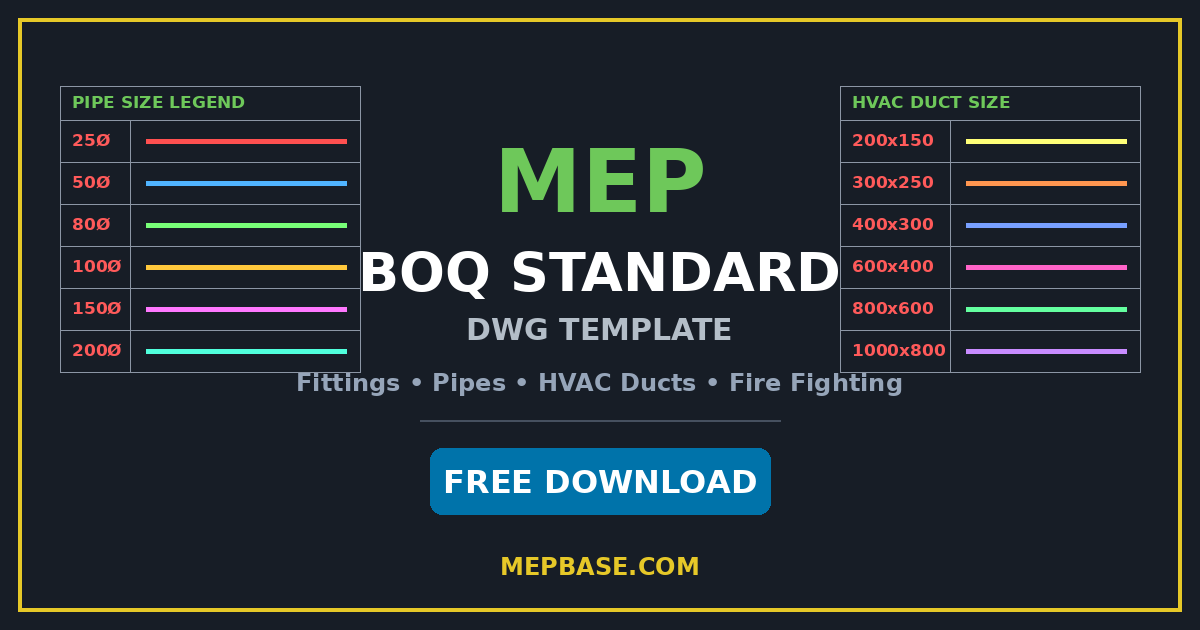
Preparing a Bill of Quantities for an MEP project is one of the most time-consuming tasks a mechanical or plumbing engineer faces. Counting every elbow, tee, reducer and valve across dozens of drawings, then measuring pipe and duct lengths line by line, can easily consume days of work. That is exactly why we are sharing this MEP BOQ Standard DWG free download – a ready-made AutoCAD quantity take-off template that organizes every fitting, pipe size and duct size into clean, color-coded tables you can drop straight into your own projects.
This template follows the standard format used on commercial and residential MEP projects across the Gulf region and beyond. Whether you are a QS engineer, a site engineer preparing variation claims, or a draftsman building shop drawings, this file will save you hours on every single BOQ.
What Is Included in This MEP BOQ Standard DWG?
The file is a single AutoCAD drawing (compatible with AutoCAD 2004 and every later version, including AutoCAD 2025) that contains four major groups of pre-built tables. Each table is fully editable native AutoCAD linework and text – no external references, no proxy objects, no missing fonts.
1. MEP Fittings Count Tables (Nos.)
Four dedicated schedules cover every wet service on a typical project, each with a fittings symbol column, count columns and a unit column:
- Drainage Pipes Fittings – equal tees, reducing tees, equal and reducing Y-fittings, double Y-fittings, reducers, 90° and 45° elbows, cleanouts, floor drains and roof drains for 50 mm to 160 mm uPVC sizes, with separate columns for SP, WP, VP and CDP systems.
- Water Supply Pipes Fittings – equal tees, reducing tees and reducers from Ø20 mm to Ø50 mm, CWS / HWS / NPW 90° elbows, gate valves, water hammer arrestors and electric water heater positions.
- Chilled Water Pipes Fittings – equal and reducing fittings with separate CHWS and CHWR count columns plus gate valves, ideal for fan coil unit and AHU piping take-offs.
- Fire Fighting Pipes Fittings – equal tees, reducing tees from 50 mm up to 150 mm, reducers and 90° elbows for sprinkler and fire hose cabinet networks.
2. Pipe Size Color Legends
Every pipe service has its own color-coded legend so quantities can be picked visually from the plan without opening layer properties:
- Fire fighting pipes from 25Ø to 200Ø
- Chilled water supply and return pipes from Ø20 to Ø150
- Condensate drain (CD) pipes from 25Ø to 50Ø
- Cold water supply, hot water supply and hot water return pipes
3. Pipe Length Measurement Tables (Meters)
This is the part senior QS engineers will appreciate most. Instead of a single length figure, every diameter is broken down into horizontal run, drop and riser quantities – the same format consultants ask for during invoice certification. Separate tables are provided for chilled water (CHWS / CHWR from Ø15 to Ø80) and domestic water (CWS, HWS, DWS and NPW from Ø20 to Ø50), each with a totals column in meters.
4. HVAC Duct Size Tables – Supply, Return, Fresh and Exhaust
Four complete duct schedules cover every rectangular size you will realistically meet on site, from 100×100 up to 1300×1300 mm. Each size has a unique color assignment, which makes duct take-off from ventilation layouts dramatically faster:
- HVAC Supply Duct Size tables – full range with color codes
- HVAC Return Duct Size tables – matching range for return air networks
- HVAC Fresh Air Duct Size tables – 100×100 to 850×850 and beyond
- HVAC Exhaust Duct Size tables – toilet, kitchen and car park exhaust sizes
Why Use a Standard BOQ Template Instead of Starting From Scratch?
Anyone who has prepared an MEP quantity take-off manually knows the pain points: inconsistent naming between drawings, missed fittings, and endless back-and-forth with the consultant over measurement format. A standardized DWG template solves all three problems at once.
Consistency Across the Whole Project
When every floor plan uses the same color for a Ø50 CHWS pipe or a 600×400 supply duct, your take-off sheets stay consistent from basement to roof. Junior engineers can pick quantities without supervision because the legend removes any guesswork.
Faster Invoicing and Variation Claims
The horizontal / drop / riser breakdown in the pipe measurement tables matches the format most consultants and cost engineers request. Quantities lifted with this template can go directly into your monthly payment application without reformatting.
Fewer Errors, Cleaner Handover
Pre-built fittings schedules act as a checklist. If the drainage table has a row for double Y-fittings and your count is zero, you know to double-check the stack details instead of discovering the miss after procurement.
How to Use This Quantity Take-Off Template
Getting productive with the file takes only a few minutes:
- Download and open the DWG in AutoCAD 2004 or any newer version. No special fonts or plug-ins are required.
- Copy the relevant legend (for example, the chilled water pipe size legend) next to your working floor plan.
- Match colors to services on your layout, or repaint your polylines to follow the template color scheme for instant visual take-off.
- Fill the count and length columns as you measure. The tables are plain AutoCAD text, so values can be edited with a double click.
- Export the totals to Excel for pricing, or plot the sheet directly as a BOQ attachment for the consultant.
Who Should Download This File?
- Quantity surveyors and cost engineers preparing tender or contract BOQs for plumbing, HVAC, chilled water and fire fighting packages
- MEP site engineers measuring executed works for monthly invoices and variation orders
- Draftsmen and BIM modelers who need a proven color and naming convention for shop drawings
- Students and fresh graduates learning how professional MEP quantity take-off sheets are structured in real projects
MEP BOQ Standard DWG Free Download
The complete AutoCAD file – all fittings schedules, pipe legends, measurement tables and the full set of HVAC supply, return, fresh and exhaust duct size tables – is available below as a free download. No registration is required.
Checking…
File details: Format DWG (AutoCAD 2004+), fully editable, model space tables, no external references. Simply download, open and start your take-off.
Frequently Asked Questions
Which AutoCAD versions can open this file?
The drawing is saved in AutoCAD 2004 format, so it opens in every AutoCAD release from 2004 through the latest version, as well as free viewers and most CAD alternatives that read DWG files.
Can I edit the tables and add my own pipe sizes?
Yes. Everything in the file is native AutoCAD linework and text. You can add rows, change sizes, adjust colors and adapt the schedules to your project specification in minutes.
Is this template suitable for consultant submissions?
The measurement format – separate horizontal, drop and riser quantities with unit columns in numbers and meters – follows the convention widely accepted by MEP consultants, so sheets produced from this template are submission-ready.
Does the free download include HVAC duct quantities?
Yes. Four complete duct schedules (supply, return, fresh air and exhaust) covering sizes from 100×100 up to 1300×1300 mm are included in the same DWG, each with its own color code for fast visual take-off.
Final Thoughts
A reliable BOQ starts with a reliable format. This MEP BOQ standard DWG free download gives you a battle-tested structure for counting fittings, measuring pipes and scheduling duct sizes across plumbing, water supply, chilled water, fire fighting and HVAC systems – all in one editable AutoCAD file. Download it, plug it into your next project, and spend your time engineering instead of formatting tables.
For more free MEP templates, CAD blocks and quantity take-off resources, keep exploring MEPBase – and if this file saved you time, share it with a colleague who is still counting elbows by hand.