kW to kVA to Amps Calculator (Single & Three Phase)
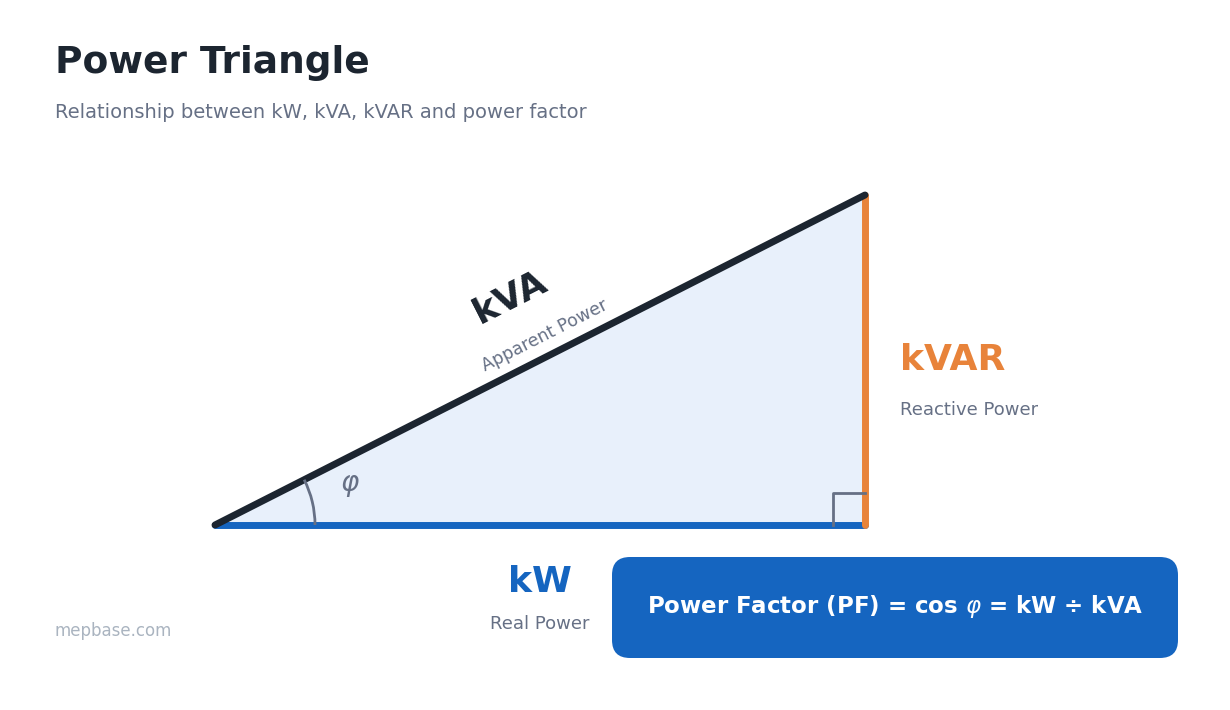
Converting between kW, kVA and Amps is one of the most common tasks in electrical and HVAC engineering — whether you are sizing a cable, selecting a circuit breaker, or finding the full-load current of a generator or transformer. The converter below gives instant results for single phase and three phase systems, followed by all the formulas, solved examples, and a ready 415V quick reference chart.
kW / kVA / Amps Converter
Three-phase uses line-to-line voltage. Apply local code (NEC/IEC) derating for actual cable & breaker sizing.
kW vs kVA vs Amps — the basic difference
Before converting, it helps to understand what each term means:
The link between all three is the power factor (PF). This is the single most important relationship to remember:
|
kVA = kW ÷ PF
kW to kVA to Amps formulas
Three-phase formulas
Here V = line-to-line voltage (e.g. 400V / 415V / 480V), √3 = 1.732, and PF = power factor.
Single-phase formulas
DC formulas
DC systems have no power factor and no kVA:
How to convert kW to Amps (step by step)
- Select the system type — single phase or three phase.
- Enter the voltage (line-to-line for three phase, e.g. 415V).
- Enter the power factor (typically 0.8 for motor/mixed loads; 1 for purely resistive loads).
- Apply the formula I = (kW × 1000) ÷ (√3 × V × PF).
- Add the appropriate safety / derating factor before finalizing cable and breaker sizes.
Solved examples
Example 1 — kW to Amps (three-phase)
100 kW load at 415V, power factor 0.8.
I = (100 × 1000) ÷ (1.732 × 415 × 0.8) = 100000 ÷ 575.0
I = 173.9 A
Example 2 — kVA to Amps (three-phase)
200 kVA transformer / generator at 415V.
I = (200 × 1000) ÷ (1.732 × 415) = 200000 ÷ 718.8
I = 278.3 A
Power factor is not used here because kVA is already apparent power.
Example 3 — kW to Amps (single-phase)
5 kW load at 230V, power factor 0.9.
I = (5 × 1000) ÷ (230 × 0.9) = 5000 ÷ 207
I = 24.2 A
Example 4 — kW to kVA
80 kW load running at 0.8 power factor.
kVA = kW ÷ PF = 80 ÷ 0.8
kVA = 100 kVA
Quick reference chart (415V, three-phase, PF = 0.8)
| Power (kW) | Apparent (kVA) | Current (Amps) |
|---|---|---|
| 1 | 1.25 | 1.7 |
| 5 | 6.25 | 8.7 |
| 7.5 | 9.4 | 13.0 |
| 10 | 12.5 | 17.4 |
| 15 | 18.75 | 26.1 |
| 20 | 25 | 34.8 |
| 25 | 31.25 | 43.5 |
| 30 | 37.5 | 52.2 |
| 40 | 50 | 69.6 |
| 50 | 62.5 | 87.0 |
| 75 | 93.75 | 130.4 |
| 100 | 125 | 173.9 |
| 150 | 187.5 | 260.9 |
| 200 | 250 | 347.8 |
| 250 | 312.5 | 434.8 |
| 300 | 375 | 521.7 |
| 500 | 625 | 869.6 |
kVA to Amps chart (415V, three-phase)
Often searched separately for transformer and generator sizing (independent of power factor):
| Rating (kVA) | Current (Amps) |
|---|---|
| 10 | 13.9 |
| 25 | 34.8 |
| 50 | 69.6 |
| 100 | 139.1 |
| 200 | 278.3 |
| 250 | 347.8 |
| 315 | 438.2 |
| 500 | 695.7 |
| 630 | 876.6 |
| 1000 | 1391.3 |
These values are at 415V and 0.8 PF; for other voltages or power factors, use the calculator above.
How power factor affects the result
The lower the power factor, the higher the current for the same kW — meaning thicker cables and a larger breaker. This is why power-factor correction matters. Common defaults:
HP to kW and Amps
Motor ratings are often given in HP, so these conversions are handy:
Use 0.736 for metric HP. Then apply the kW → Amps formula above to find the current.
Common voltage reference
| System | Typical Voltage |
|---|---|
| Single phase | 120V / 230V / 240V |
| Three phase (LV) | 400V / 415V / 480V |
Frequently Asked Questions
How many amps is 1 kVA at 415V three phase?
1 kVA ≈ 1.39 A at 415V three phase. Formula: I = (1 × 1000) ÷ (1.732 × 415) = 1.39 A.
Is kW the same as kVA?
No. kW is real power and kVA is apparent power, related by kW = kVA × power factor. They are equal only when the power factor is 1.
What is the kW to amps formula for three phase?
I = (kW × 1000) ÷ (√3 × V × PF), where V is the line-to-line voltage.
How many amps is 100 kW at 415V?
At 0.8 PF, 100 kW ≈ 173.9 A at 415V three phase.
How do I convert kW to kVA?
kVA = kW ÷ power factor. Example: 80 kW at 0.8 PF = 100 kVA.
Conclusion
Converting between kW, kVA and Amps is a basic step in every electrical design — from cable sizing to breaker and transformer selection. The converter above gives instant, standard-based results, and the formulas and charts let you verify them by hand. Always apply the derating and safety factors required by your local code (NEC / IEC) when finalizing a design.
Disclaimer: This tool is for reference only. Final electrical design should be verified by a qualified engineer in accordance with applicable standards (NEC / IEC 60038 / IEEE).