Fire Alarm Battery Calculation Step by Step (NFPA 72)
When the mains power fails during a fire, the fire alarm system runs on its batteries. If they are too small, the sounders fall silent just when people need to leave. This guide walks through fire alarm battery calculation step by step to NFPA 72: standby and alarm currents, the required durations, the 20% safety margin, battery selection and charger checks, with a full worked example.
What NFPA 72 requires from the secondary supply
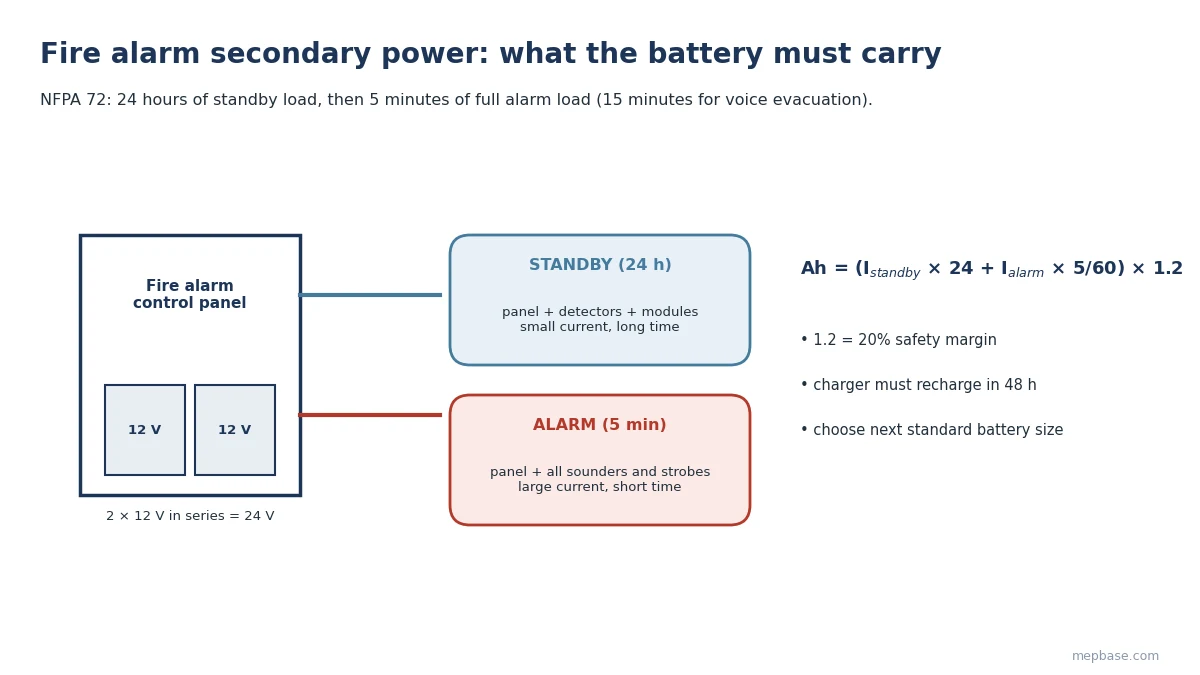
The battery (secondary power supply) must run the whole system for its standby period and then operate all alarm devices for the alarm period:
| System | Standby | Then alarm |
|---|---|---|
| Fire alarm system (general) | 24 hours | 5 minutes at maximum load |
| Emergency voice / alarm communication system | 24 hours | 15 minutes at maximum load |
| Releasing service (FM-200, deluge, pre-action) | 24 hours | 5 minutes, plus release devices |
Local codes can ask for more. Saudi SBC 801 references NFPA 72; projects to BS 5839-1 or EN 54-4 use their own durations and factors, so check the code adopted for the project.
Step 1: List the standby and alarm current of every device
From each datasheet, take the current drawn in normal standby and in alarm. Typical items are:
- Control panel and power supplies: their own standby and alarm current.
- Detectors and modules: small standby currents (microamps each) that add up over many devices.
- Notification appliances: horns, strobes and speakers draw nothing in standby but most of the alarm current.
- Auxiliary loads: door holders, annunciators, beam detectors and release solenoids, if powered from the panel.
Step 2: Calculate the battery capacity
Ah = (Istandby × 24 + Ialarm × talarm) × 1.2
- Istandby and Ialarm are the total currents in amps
- talarm = 5 / 60 h (5 minutes), or 15 / 60 h for voice evacuation
- 1.2 = 20% safety margin for battery ageing and temperature, widely applied and required by many panel manufacturers
Step 3: Select the battery and check the charger
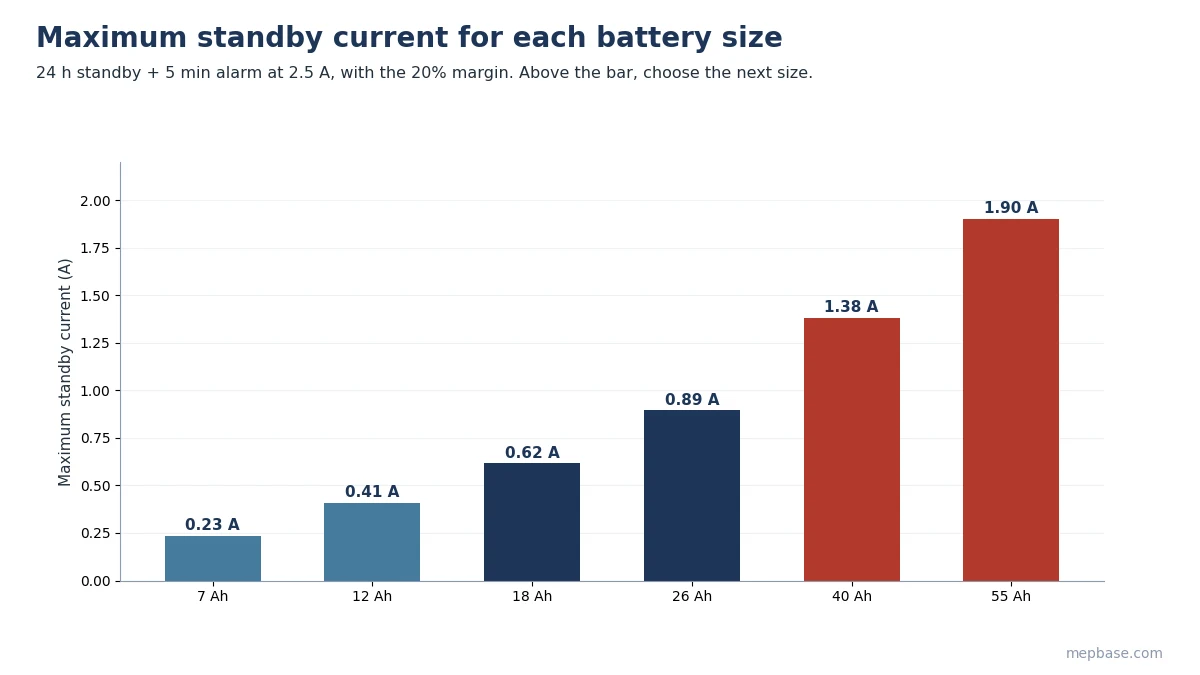
- Choose the next standard sealed lead-acid (VRLA) size: 7, 12, 18, 26, 40 or 55 Ah at 12 V. A 24 V panel uses two batteries in series, each with the full Ah rating.
- Check the panel’s maximum battery size and its charger: NFPA 72 requires the charger to recharge fully discharged batteries within 48 hours.
- Label the batteries with the installation date and replace them according to the manufacturer, typically every 3–5 years.
Fire alarm battery calculation: worked example
A small office has one panel, 60 smoke detectors, 10 manual call points and modules, and 20 horn-strobes on a 24 V system. Values are from typical datasheets:
| Device | Qty | Standby (A) | Alarm (A) |
|---|---|---|---|
| Control panel | 1 | 0.120 | 0.250 |
| Smoke detectors (90 µA standby) | 60 | 0.0054 | 0.045 |
| Manual call points and modules | 10 | 0.003 | 0.003 |
| Horn-strobes (110 mA in alarm) | 20 | 0 | 2.200 |
| Total | 0.1284 | 2.498 |
| Step | Calculation | Result |
|---|---|---|
| Standby energy | 0.1284 × 24 | 3.082 Ah |
| Alarm energy (5 min) | 2.498 × 5 / 60 | 0.208 Ah |
| With 20% margin | (3.082 + 0.208) × 1.2 | 3.95 Ah |
| Battery selected | next standard size | 2 × 12 V 7 Ah in series |
| Voice evacuation (15 min) check | (3.082 + 2.498 × 0.25) × 1.2 | 4.45 Ah, still 7 Ah |
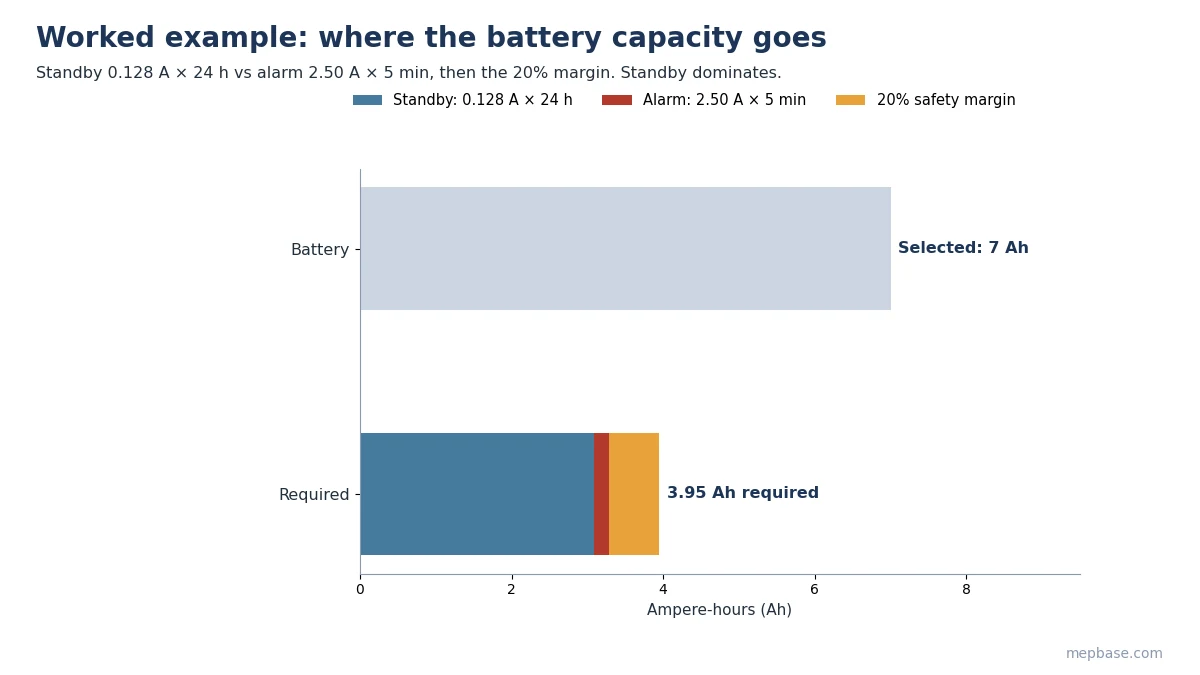
The example shows a useful point: the 24-hour standby load uses about 15 times more energy than the 5-minute alarm. Choosing low-standby-current detectors and modules often saves more battery capacity than reducing the number of sounders.
Check your own panel with the Fire Alarm Battery Calculator, lay out the detectors with the Smoke Detector Spacing Calculator, and for the extinguishing system the panel releases, see FM-200 Calculation.
Design tips for hot climates
- Battery capacity is rated at 20–25 °C. In hot plant rooms the capacity holds up, but battery life falls sharply; VRLA life roughly halves for every 10 °C above 25 °C, so keep panels in air-conditioned rooms where possible.
- In cold locations capacity drops, so add margin or use the manufacturer’s temperature derating.
- Check the voltage at the end of the alarm period: the last device on each notification circuit must still receive its minimum operating voltage when the battery is near discharge.
Common mistakes
- Using the alarm current only and forgetting that 24 hours of standby usually needs more capacity.
- Leaving out the 20% margin, so the battery passes on day one but fails after ageing.
- Taking currents from catalogue front pages instead of the datasheet table for the actual voltage and candela setting.
- Fitting a battery larger than the panel’s charger can recharge within 48 hours.
- Forgetting auxiliary loads such as door holders, beam detectors and release solenoids.
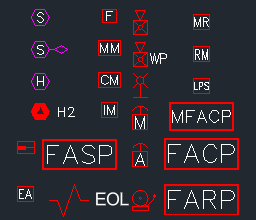
For drawings, see Fire Alarm Shop Drawing, Fire Alarm AutoCAD Blocks and Fire Alarm Symbols DWG.
Frequently asked questions
How do you calculate fire alarm battery size?
Ah = (standby current × 24 h + alarm current × 5/60 h) × 1.2. Add up the standby and alarm currents of all devices from their datasheets, apply the formula and choose the next standard battery size.
How long must fire alarm batteries last under NFPA 72?
24 hours of standby followed by 5 minutes of alarm at full load, or 15 minutes for an emergency voice/alarm communication system.
Why add a 20% safety margin?
Battery capacity falls with age and at low temperature. The 20% margin makes sure the battery still meets the duration near the end of its service life.
How long should fire alarm batteries last before replacement?
Sealed lead-acid batteries are typically replaced every 3–5 years, sooner in hot rooms. Test them during routine maintenance and replace any that fail the load test.
Do 24 V panels need two batteries?
Yes, most 24 V panels use two 12 V batteries in series. Each battery has the full Ah rating calculated; two 12 V 7 Ah batteries in series give 24 V 7 Ah.