Fire Water Tank Sizing: How to Calculate Fire Reserve Capacity Step by Step
A fire pump is only as good as the water behind it. If the tank runs dry before the required duration, the system fails exactly when it is needed. This guide walks through fire water tank sizing step by step: sprinkler demand, hose stream allowance, duration, standpipe check, effective versus gross capacity, refill rate and combined domestic and fire tanks, with a full worked example.
What the fire water tank must hold
The tank must supply the largest fire protection demand it serves, at full flow, for the full required duration:
Required effective volume = Total demand flow × Duration
“Effective” means water that the fire pump can actually use, between the lowest usable level and the overflow. NFPA 13 and NFPA 14 set the flows and durations, and NFPA 22 covers the tank itself. Local fire codes and the authority having jurisdiction often set their own minimum volumes, so always check them as well.
Step 1: Get the sprinkler system demand
Take the flow at the base of the riser from the hydraulic calculation of the most demanding design area. This already includes the design density over the design area plus the extra flow from overpressure at sprinklers nearer the riser. See Fire Fighting System Design Calculation for the method, and check density and area with the Sprinkler Density Calculator.
Step 2: Add the hose stream allowance and set the duration
NFPA 13 adds a hose stream allowance and sets a minimum duration based on the occupancy hazard. For hydraulically calculated systems:
| Occupancy hazard | Inside + outside hose allowance | Duration |
|---|---|---|
| Light hazard | 100 GPM (379 L/min) | 30 minutes |
| Ordinary hazard | 250 GPM (946 L/min) | 60 to 90 minutes |
| Extra hazard | 500 GPM (1,893 L/min) | 90 to 120 minutes |
Where a range is given, the lower duration is only permitted when the sprinkler waterflow and supervisory alarms are electrically supervised and monitored at an approved, constantly attended location; otherwise use the higher value. Storage occupancies covered by the storage chapters of NFPA 13 can need longer durations and larger hose allowances.
Step 3: Check the standpipe demand
If the same tank feeds standpipes, calculate their demand separately. For Class I and III standpipes, NFPA 14 requires 500 GPM for the first standpipe plus 250 GPM for each additional standpipe (up to 1,000 GPM in fully sprinklered buildings) for at least 30 minutes. Use the Standpipe Calculator to check flows. The tank is sized on whichever demand gives the larger volume, unless the local code requires the volumes to be added.
Step 4: Convert effective volume to gross tank size
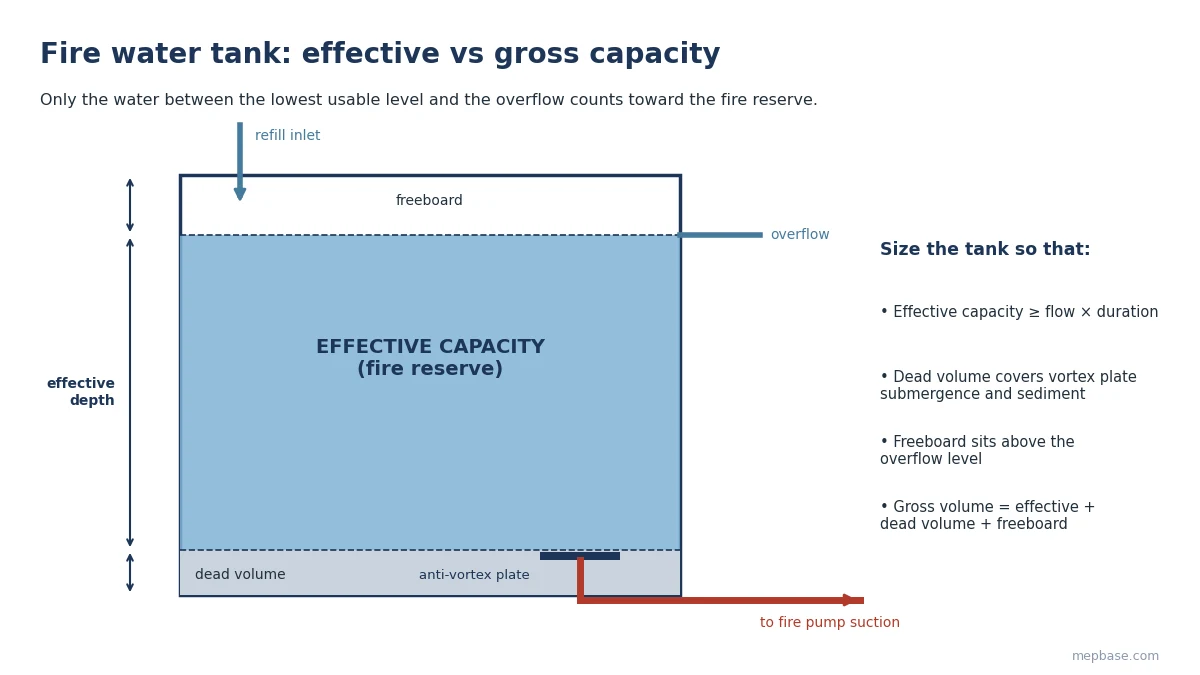
A tank never empties completely through the fire pump suction. Add allowances below and above the effective water:
- Dead volume: water below the lowest usable level, covering the submergence needed above the anti-vortex plate and space for sediment.
- Freeboard: air space above the overflow level.
- Gross volume = Effective volume + Dead volume + Freeboard
Splitting the tank into two compartments, each with its own suction to the fire pump, lets one side be cleaned or repaired while the other stays in service. For the pump side of the design, see Fire Pump Sizing to NFPA 20.
Step 5: Check the refill rate
Refill rate = Effective volume / Refill time
NFPA 22 commonly expects a tank to be refillable within 8 hours from a reliable automatic supply. Size the incoming water connection, float valve and any transfer pumps for this flow.
Combined domestic and fire water tanks
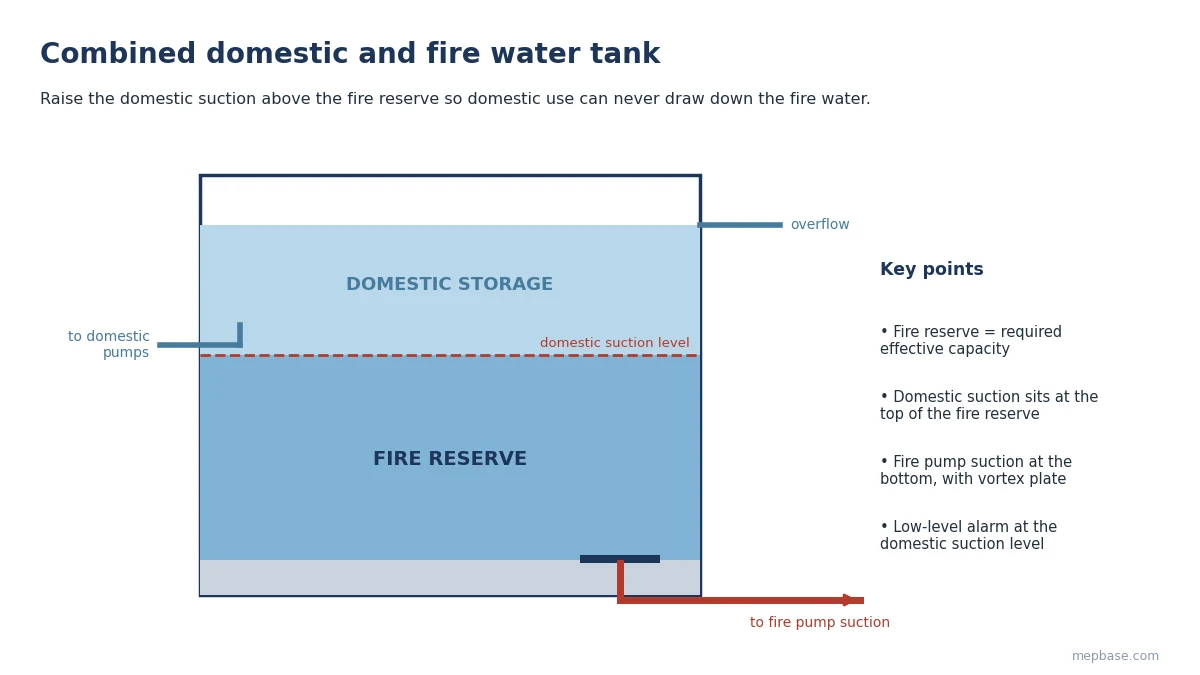
Many buildings use one tank for both domestic and fire water. The fire reserve must be protected so domestic use can never draw it down. The usual method is to raise the domestic pump suction to the top of the fire reserve, so domestic pumps lose suction before the fire water is touched, and to fit a low-level alarm at that level.
Fire water tank sizing: worked example for an ordinary hazard warehouse
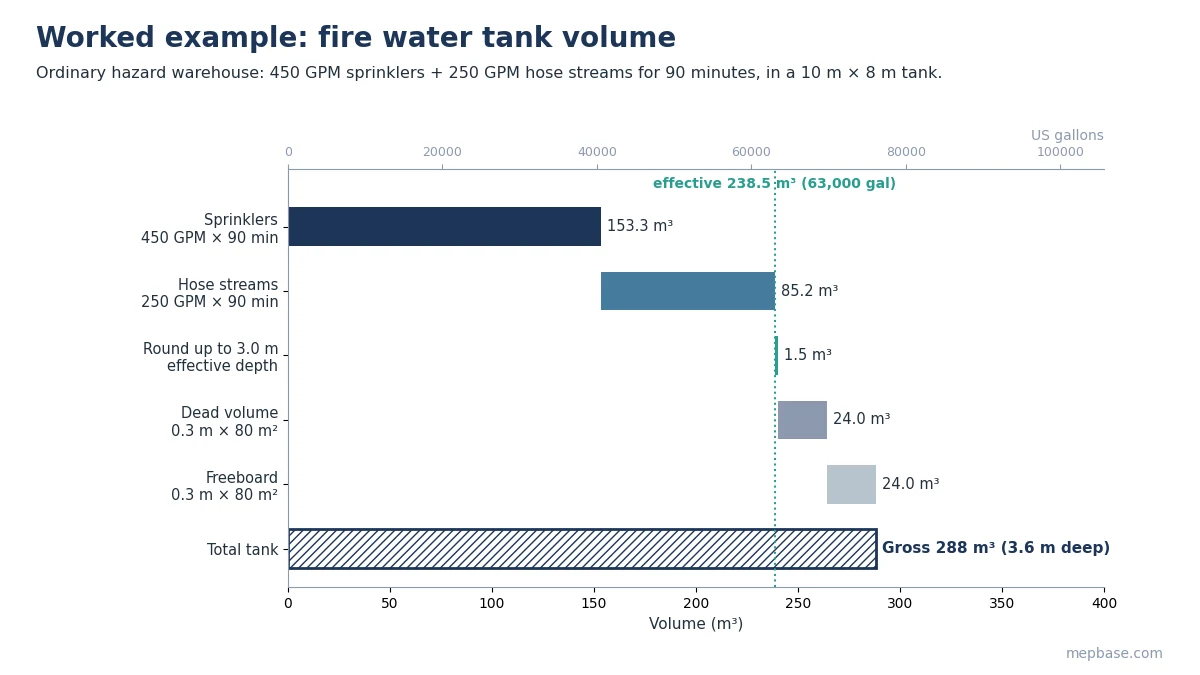
An ordinary hazard warehouse is protected by sprinklers and two Class I standpipes. The hydraulic calculation gives a sprinkler demand of 450 GPM at the base of the riser. The authority requires the 90-minute duration. The tank plan area available is 10 m × 8 m.
| Step | Calculation | Result |
|---|---|---|
| Sprinkler demand | hydraulic calculation | 450 GPM |
| Hose stream allowance | ordinary hazard | 250 GPM |
| Total demand | 450 + 250 | 700 GPM (2,650 L/min) |
| Duration | ordinary hazard, upper value | 90 minutes |
| Effective volume (sprinklers) | 700 × 90 | 63,000 gal (238.5 m³) |
| Standpipe check | (500 + 250) × 30 | 22,500 gal (85 m³): sprinklers govern |
| Effective depth | 238.5 / 80 = 2.98 m | use 3.0 m (240 m³) |
| Dead volume | 0.3 m × 80 m² | 24 m³ |
| Freeboard | 0.3 m × 80 m² | 24 m³ |
| Gross tank | 10 m × 8 m × 3.6 m | 288 m³ (76,100 gal) |
| Refill rate (8 hours) | 240 / 8 | 30 m³/h (8.3 L/s, 132 GPM) |
Run your own numbers in the Fire Water Tank Calculator, then size the pump that draws from it with the Fire Pump Selection Calculator.
Common mistakes
- Sizing on gross tank volume, so the dead volume and freeboard eat into the fire reserve.
- Forgetting the hose stream allowance in the volume calculation.
- Using the sprinkler demand when the standpipe or hydrant demand gives a larger volume.
- Letting domestic pumps draw from the same level as the fire pump in a combined tank.
- Ignoring the local authority’s minimum volume, which can be larger than the NFPA calculation.
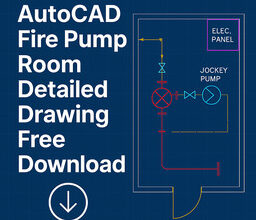
For pump room and tank connection drawings, see the Fire Pump Room DWG.
Frequently asked questions
How do you calculate fire water tank capacity?
Multiply the total demand flow (sprinklers plus hose stream allowance, or the standpipe demand if larger) by the required duration, then add dead volume and freeboard to get the gross tank size.
How long must a fire water tank supply the system?
Under NFPA 13, 30 minutes for light hazard, 60 to 90 minutes for ordinary hazard and 90 to 120 minutes for extra hazard. Standpipes need at least 30 minutes under NFPA 14. Local codes may require more.
What is the effective capacity of a fire water tank?
It is the volume between the lowest level the fire pump can draw from without vortexing and the overflow level. Only this volume counts toward the fire reserve.
Can domestic and fire water share one tank?
Yes, if the fire reserve is protected, usually by raising the domestic suction to the top of the fire reserve so domestic use cannot draw it down.