AC Tonnage Chart — What Size AC Do You Need? (Room Size to Tons, Free Chart)
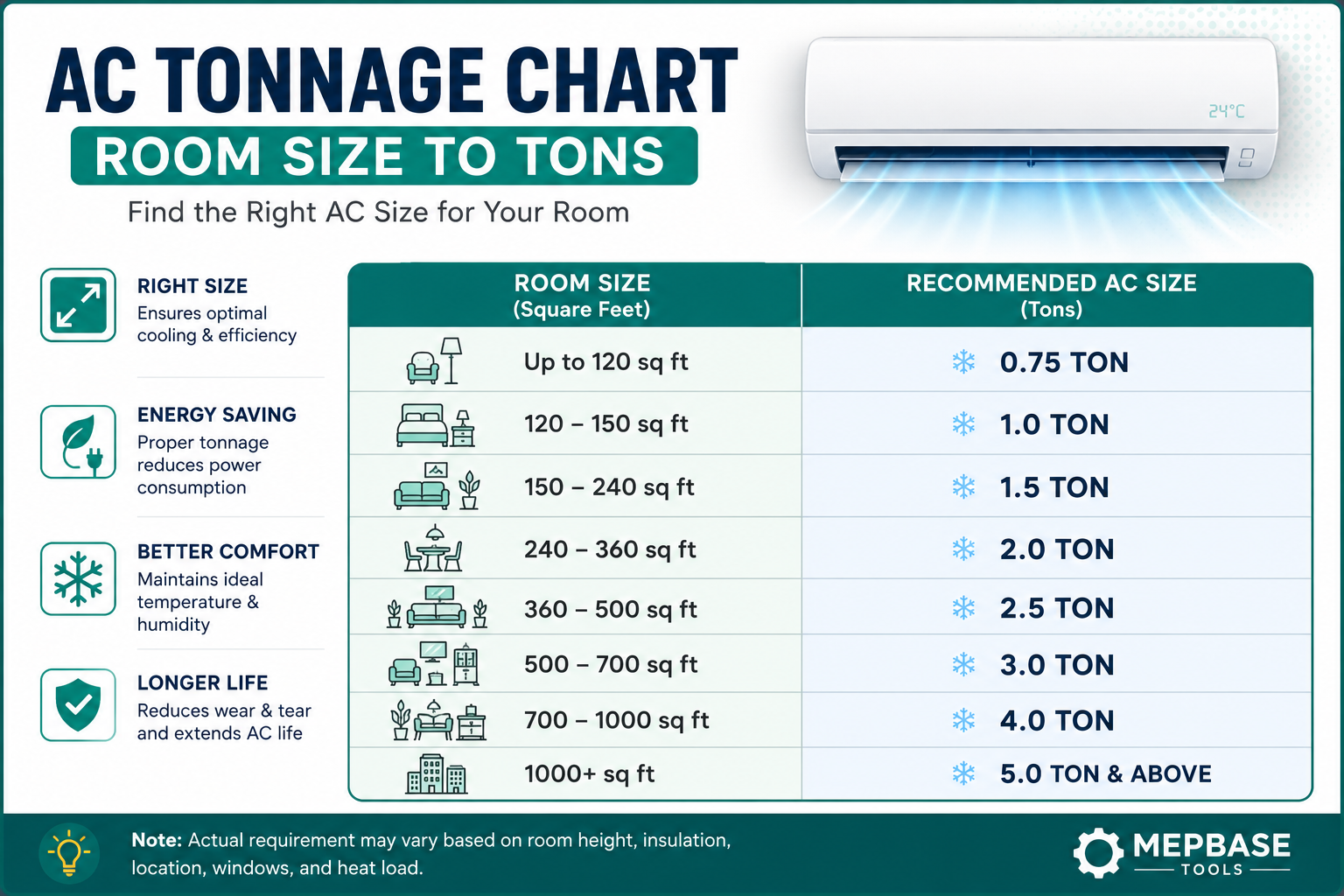
Choosing an air conditioner starts with one question: what size do I need? The answer is measured in tons — and getting it wrong in either direction costs you. Below is a complete AC tonnage chart by room size, in both sq ft and m², for moderate and hot climates.
Quick Answer: The AC Tonnage Chart
1 ton of air conditioning = 12,000 BTU/hr = 3.517 kW. But before you read any chart, you need to know one thing that most sizing charts get wrong:
A single room needs far more BTU per square foot than a whole house. A bedroom carries its own external wall, its own window and its own fresh-air load — all divided by a small floor area. A whole house averages those exterior rooms together with interior rooms, corridors and bathrooms that have almost no heat gain. That’s why there are two charts below, not one.
AC Tonnage Chart — Single Room (Bedroom, Living Room, Office Cabin)
Use this when you’re cooling one room with a split or window unit.
| Room Size (sq ft) | Room Size (m²) | Moderate Climate | Warm Climate | Hot Climate (Gulf/India) |
|---|---|---|---|---|
| 100 – 150 | 9 – 14 | 0.75 Ton | 0.75 Ton | 1.0 Ton |
| 150 – 250 | 14 – 23 | 1.0 Ton | 1.5 Ton | 1.5 Ton |
| 250 – 400 | 23 – 37 | 2.0 Ton | 2.0 Ton | 2.5 Ton |
| 400 – 600 | 37 – 56 | 2.5 Ton | 3.0 Ton | 3.5 Ton |
| 600 – 900 | 56 – 84 | 4.0 Ton | 5.0 Ton | 5.0 Ton |
Moderate ≈ 32°C design day · Warm ≈ 38°C · Hot ≈ 46°C. Average insulation, normal sun, 2.7 m (9 ft) ceiling.
AC Tonnage Chart — Whole Apartment or House
Use this for central or ducted systems cooling an entire home.
| Home Size (sq ft) | Home Size (m²) | Moderate Climate | Warm Climate | Hot Climate |
|---|---|---|---|---|
| 600 – 800 | 56 – 74 | 1.5 Ton | 1.5 Ton | 2.0 Ton |
| 800 – 1000 | 74 – 93 | 2.0 Ton | 2.0 Ton | 2.5 Ton |
| 1000 – 1400 | 93 – 130 | 2.5 Ton | 3.0 Ton | 3.5 Ton |
| 1400 – 1800 | 130 – 167 | 3.0 Ton | 3.5 Ton | 4.0 Ton |
| 1800 – 2400 | 167 – 223 | 4.0 Ton | 5.0 Ton | 6.0 Ton |
| 2400 – 3000 | 223 – 279 | 5.0 Ton | 6.0 Ton | 7.5 Ton |
Skip the Chart — Use the Free Calculator
Charts assume “average” everything. Your room might face west with a huge window, or sit under an uninsulated roof. The free AC Tonnage Calculator takes your actual climate, insulation, sun exposure, ceiling height, occupants and appliances — and gives you the BTU/hr, kW and ton size in one click. It also has a Detailed Load mode for engineers: walls, glass orientation, glazing type, people, lighting, equipment and ventilation, with a full sensible/latent breakdown.
❄️ Open the Free AC Tonnage Calculator
How AC Tonnage Is Calculated
The chart above comes from a simple formula:
BTU/hr = Area (sq ft) × Base BTU/ft² × Climate × Insulation × Sun × Ceiling factor
Tons = BTU/hr ÷ 12,000 → round up to the next standard size
The base intensity depends on what you’re cooling:
- Single exterior room (bedroom, living room, office cabin): 55–60 BTU/ft²
- Whole apartment or house: 22 BTU/ft² — the familiar “20 BTU per sq ft” figure
- Open-plan office floor: 35 BTU/ft²
- Retail shop: 45 · Restaurant: 60 · Commercial kitchen: 85 BTU/ft²
Climate multipliers: moderate ×0.85, warm ×1.00, hot/Gulf ×1.20, hot & humid coastal ×1.25. Insulation: good ×0.90, average ×1.00, poor ×1.15. Sun: shaded ×0.90, normal ×1.00, very sunny ×1.10.
Worked Example — 150 sq ft Bedroom in Riyadh
- Base: 150 sq ft × 55 BTU/ft² = 8,250 BTU/hr
- Hot climate ×1.20, average insulation ×1.00, normal sun ×1.00 = 9,900 BTU/hr
- Tons = 9,900 ÷ 12,000 = 0.83 → 1 Ton unit
Cross-check with the engineering method: a full component load calculation for the same room (10 m² block wall, 2 m² west window, 46°C outdoor / 24°C indoor, 2 people, 8 L/s fresh air, 10% safety) gives 3,029 W = 0.86 tons. Two completely different routes, same answer — that’s how you know a rule of thumb is sound.
Commercial AC Tonnage Examples (Hot Climate)
| Space | Example Size | Cooling Load | AC Size |
|---|---|---|---|
| Small office / cabin | 200 sq ft | 14,400 BTU/hr | 1.5 Ton |
| Retail shop | 800 sq ft | 43,200 BTU/hr | 4.0 Ton |
| Commercial kitchen | 400 sq ft | 40,800 BTU/hr | 3.5 Ton |
| Restaurant / cafe | 1,000 sq ft | 72,000 BTU/hr | 6.0 Ton |
| Open-plan office floor | 2,000 sq ft | 84,000 BTU/hr | 7.5 Ton |
Server rooms are a special case — the load is driven almost entirely by IT equipment watts, not floor area. Enter the actual kW in the calculator’s appliance field.
Why Oversizing Is Worse Than You Think
The instinct is “buy a bigger one to be safe.” That’s a mistake:
- Short-cycling: an oversized AC cools the air fast, hits setpoint, and shuts off — before it has run long enough to dehumidify. You get a room that’s cold and clammy.
- Higher humidity: less runtime = less moisture removed. In Gulf and coastal climates this is a real comfort and mould problem.
- Compressor wear: frequent starts are what kill compressors, not long runs.
- Wasted money: higher purchase price, higher installed cost, worse part-load efficiency.
Undersizing has the opposite failure: the unit runs continuously and still never holds setpoint on a design day. Correct sizing beats extra capacity.
What the Chart Doesn’t Know About Your Room
Any chart assumes averages. These factors can shift your load by 30% or more:
- Glass and orientation: a west-facing window can add ~550 W/m² of solar gain at peak — often more than the entire wall around it. South-East and East are next worst in the morning.
- Roof exposure: a top-floor room under an uninsulated roof can carry double the load of the same room mid-building.
- Ceiling height: a 4 m ceiling means ~50% more air volume than a 2.7 m one.
- Fresh air: in a hot-humid climate, ventilation air can be 20–30% of the total load — most of it latent (moisture).
- Equipment: every watt of appliance power becomes 3.412 BTU/hr of heat in the room.
The calculator’s Detailed Load mode handles all of these individually.
FAQ — AC Tonnage
How many tons of AC do I need per square foot?
It depends on what you’re cooling. Whole apartment/house: about 1 ton per 400–600 sq ft in moderate climates (~22 BTU/hr per sq ft). Single exterior room: about 1 ton per 150–250 sq ft (~55–70 BTU/hr per sq ft), because that room carries its own wall, window and fresh-air load over a small floor area.
What size AC do I need for a 150 sq ft room?
About 0.75 ton in a moderate climate and 1 ton in a hot climate like the Gulf or India. That’s roughly 8,250–9,900 BTU/hr.
How many BTU is 1 ton of AC?
1 ton = 12,000 BTU/hr = 3.517 kW. The term comes from the cooling effect of melting one short ton of ice over 24 hours. So 1.5 ton = 18,000 BTU/hr and 2 ton = 24,000 BTU/hr.
What happens if my AC is oversized?
It short-cycles — cooling quickly then shutting off before it can dehumidify. You get a cold but humid, clammy room, higher indoor humidity, more compressor wear from frequent starts, and higher install and running costs.
Is an AC tonnage chart accurate enough for design?
It’s fine for buying decisions, budgeting and sanity-checking a contractor’s quote. For construction design and submittals, you need a full load calculation to ACCA Manual J or ASHRAE methods — typically using software like Carrier HAP.
Next Steps
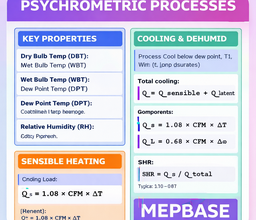
Once you know the tonnage, the rest of the HVAC design follows. Convert tons to airflow with the TR to CFM Calculator (1 TR ≈ 400 CFM), size the ductwork with the Online Ductulator, check condensation risk with the Dew Point Calculator, and grab our free printable psychrometric chart PDF.
For more free HVAC tools, charts and downloads — stay tuned with MEPBase.com.