HVAC Load Calculation Guide (Cooling & Heating)
HVAC load calculation is the most important step in HVAC system design. Accurate cooling and heating load calculations ensure correct equipment sizing, energy efficiency, and indoor comfort. This detailed guide explains HVAC load calculations step by step, covering external loads, internal loads, ventilation loads, heating losses, and industry-standard methods used by HVAC engineers worldwide.
What Is HVAC Load Calculation?
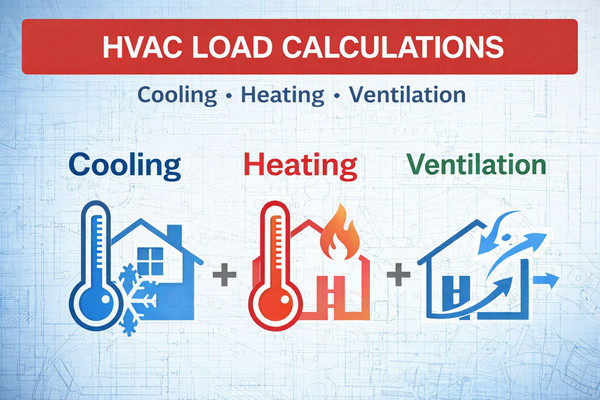
HVAC load calculation is the process of estimating the total amount of heat that must be removed or added to a building to maintain indoor design conditions. It forms the basis for sizing HVAC systems for air conditioning and heating equipment.
A complete building heat load calculation includes:
- Sensible heat load (temperature change)
- Latent heat load (moisture removal)
- Ventilation and infiltration air loads
- Transmission losses during heating
External Cooling Loads
External loads are heat gains that enter the building from outdoors through walls, roofs, windows, and air leakage.
1. Wall and Roof Heat Transfer (Conduction Load)
Q = U × A × CLTDcorr
Where:
- U = Overall heat transfer coefficient
- A = Surface area
- CLTDcorr = Corrected Cooling Load Temperature Difference
The CLTD/CLF method accounts for solar exposure, wall orientation, roof color, latitude, and time of year.
2. Window Heat Gain – Conduction
Q = U × A × (To − Ti)
Window U-values are taken from NFRC tables. High-performance glazing significantly reduces HVAC cooling load.
3. Window Solar Heat Gain
Q = A × SHGC × SC × SCL × CLF
Solar heat gain through windows is often the largest contributor to cooling load in commercial buildings.
Infiltration Heat Gain
Infiltration occurs due to uncontrolled outdoor air entering the building. It adds both sensible and latent heat loads.
Sensible Load:
Qs = CFM × 1.08 × ΔT
Latent Load:
Ql = CFM × 0.68 × ΔW
CFM can be calculated using crack method or air changes per hour (ACH).
Internal Cooling Loads
Occupant (People) Heat Load
Occupants generate both sensible and latent heat.
Qs = N × qs × CLF
Ql = N × ql
Typical ASHRAE values:
- Seated occupants: 245 sensible, 205 latent BTU/hr
- Office work: 250 sensible, 200 latent BTU/hr
- Light activity: 250 sensible, 250 latent BTU/hr
Lighting Load Calculation
Q = W × 3.41 × Fu × Fsa × CLF
Lighting load depends on fixture type. LED lighting produces lower heat gain compared to fluorescent lighting.
Equipment and Appliance Load
Q = Power × Fu × Fr × CLF
Motor heat gain:
Q = HP × 2545
Manufacturer data should always be used where available.
Ventilation Load Calculation (ASHRAE 62.1)
Ventilation load is calculated based on required outdoor air as per ASHRAE Standard 62.1.
Voz = Rp × Pz + Ra × Az
Sensible Ventilation Load:
Qs = 1.08 × CFM × (To − Ti)
Latent Ventilation Load:
Ql = 0.68 × CFM × (Wo − Wi)
Duct Heat Gain and Safety Factor
Duct heat gain or loss must be considered when ducts pass through unconditioned spaces.
Q = Uduct × Aduct × ΔT
A HVAC safety factor of 10–20% is added to account for uncertainties, future equipment, and distribution losses.
Heating Load Calculation
Transmission Heat Loss
Q = U × A × (Ti − To)
Infiltration Heat Loss
Q = CFM × 1.08 × (Ti − To)
Basement and Slab Heat Loss
Q = F × P × (Ti − To)
Additional pickup load of 10–40% is applied for morning warm-up and building thermal mass.
Total HVAC Load Summary
Qtotal = Qsensible + Qlatent
Cooling Capacity (TR) = Qtotal / 12,000
Diversity factors are applied since all loads do not peak simultaneously.
HVAC Load Calculation Standards and Methods
- RTS Method (Radiant Time Series)
- CLTD / CLF Method
- Transfer Function Method (TFM)
- Manual J (Residential Load Calculation)
Related HVAC Tools on MEPBase
Conclusion
A proper HVAC load calculation is essential for efficient HVAC design. By correctly estimating cooling and heating loads using ASHRAE methods, engineers can select optimal equipment capacity, reduce energy consumption, and ensure long-term system reliability.