Kitchen Exhaust Hood CFM Calculation and Grease Duct Design (NFPA 96 and IMC)
Too little exhaust and smoke rolls into the kitchen; a badly built grease duct is a fire waiting to happen. This guide walks through the kitchen hood CFM calculation step by step: classifying appliances by duty, calculating exhaust airflow, sizing the grease duct to NFPA 96, and setting make-up air, with a full worked example.
Why kitchen exhaust is different
A commercial kitchen hood must capture heat, smoke and grease-laden vapour from cooking appliances and carry it outside without letting grease build up in the duct. Too little exhaust and smoke spills into the kitchen. A badly designed grease duct is one of the most common origins of restaurant fires. Kitchen exhaust is therefore governed by NFPA 96 and, where adopted, the International Mechanical Code (IMC), on top of normal HVAC practice.
Step 1: Classify the appliances by duty
Group the cooking line by the heaviest duty under each hood section:
- Light duty: ovens, steamers, kettles, rice cookers.
- Medium duty: fryers, griddles, ranges, tilting skillets.
- Heavy duty: gas charbroilers, upright broilers, woks.
- Extra-heavy duty: solid fuel appliances (wood, charcoal).
If appliances of different duty share one hood, the whole hood is sized for the heaviest duty, unless the hood is segmented with separate exhaust sections.
Step 2: Calculate exhaust airflow
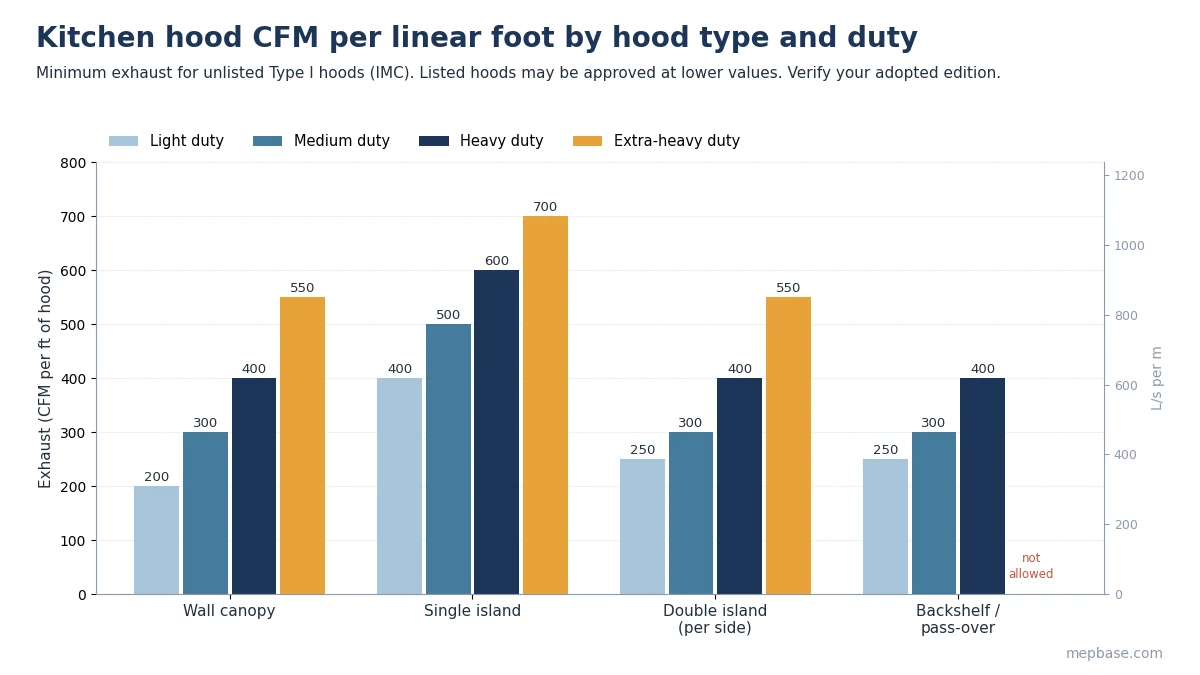
For unlisted Type I hoods, the IMC gives minimum exhaust per linear foot of hood by hood style and duty:
| Hood type | Light duty (CFM/ft) | Medium duty (CFM/ft) | Heavy duty (CFM/ft) | Extra-heavy (CFM/ft) |
|---|---|---|---|---|
| Wall-mounted canopy | 200 | 300 | 400 | 550 |
| Single island canopy | 400 | 500 | 600 | 700 |
| Double island canopy (per side) | 250 | 300 | 400 | 550 |
| Backshelf / pass-over | 250 | 300 | 400 | not allowed |
Exhaust CFM = Hood length (ft) × CFM per ft
In SI, 100 CFM/ft is about 155 L/s per metre. Values are from IMC Table 507.13 (507.5 in recent editions). Confirm against the edition adopted on your project. Hoods listed to UL 710 can be approved at the lower airflow shown in their listing, which often saves 20 to 30%.
An alternative check for canopy hoods is face velocity: Exhaust CFM = Hood open area (ft²) × 50 to 100 fpm. Use it as a cross-check, not the primary method.
Step 3: Size the grease duct
NFPA 96 sets a minimum velocity of 500 fpm (2.5 m/s) in grease ducts. In practice, designers use 1,500 to 1,800 fpm (7.5 to 9 m/s) to keep grease in suspension and avoid oversized ducts, while staying below about 2,500 fpm (12.7 m/s) for noise.
Duct area (ft²) = Exhaust CFM / Design velocity (fpm)
Other NFPA 96 requirements that shape the duct design:
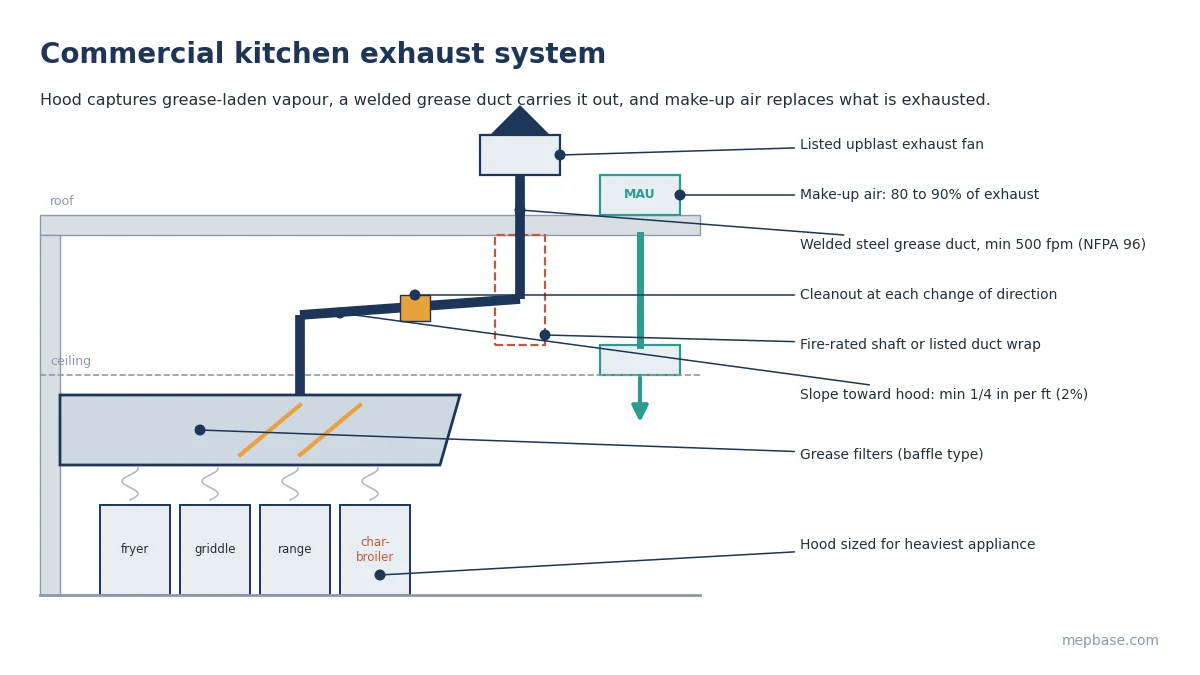
- Material: carbon steel at least 0.054 in (1.37 mm, 16 gauge) or stainless steel at least 0.043 in (1.09 mm, 18 gauge).
- Joints: continuous liquid-tight welds, no screws or rivets penetrating the duct.
- Slope: horizontal runs slope toward the hood or a grease reservoir at not less than 1/4 in per ft (2%); runs longer than 75 ft (23 m) need 1 in per ft (8.3%).
- Access: cleanout openings at each change of direction and at regular intervals on horizontal runs.
- Enclosure: a fire-rated shaft where the duct passes through floors, or a listed duct wrap system.
- Clearance: 18 in (457 mm) to combustible materials unless a listed clearance reduction system is used.
Step 4: Make-up air
Every CFM exhausted must be replaced. Supply 80 to 90% of the exhaust as dedicated make-up air, and let the rest transfer in from the dining area so the kitchen stays slightly negative and odours don’t drift out. In hot climates, temper or partly cool the make-up air; dumping hot outside air straight into the kitchen is a common comfort complaint.
Step 5: Fan static pressure
The exhaust fan must overcome the hood and filter loss (typically 0.5 to 1.0 in.wg / 125 to 250 Pa), duct friction and fittings, and the fan discharge. Use the same index run approach as in External Static Pressure (ESP) Calculation for AHU and FCU. Grease exhaust fans should be listed for the purpose (UL 762), typically upblast roof fans with hinged bases for cleaning.
Kitchen hood CFM calculation: worked example for a 12 ft canopy hood
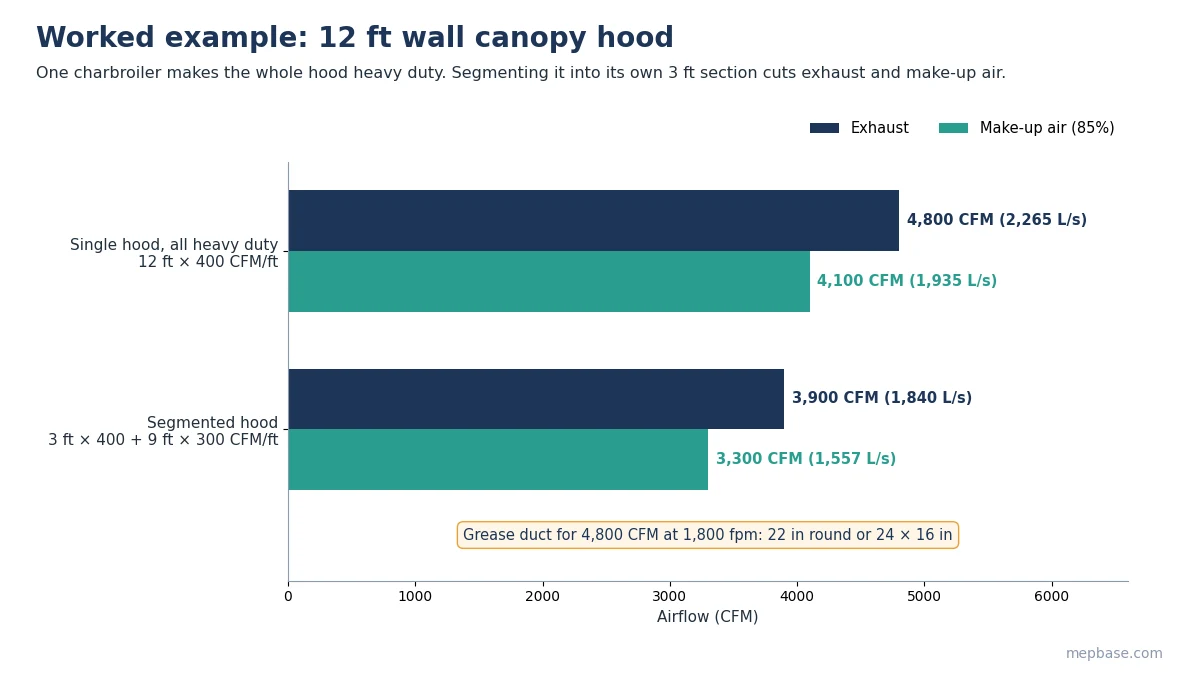
A 12 ft (3.66 m) wall-mounted canopy hood covers two fryers, a griddle, a range and one gas charbroiler. The charbroiler makes the whole hood heavy duty.
| Step | Calculation | Result |
|---|---|---|
| Duty | heaviest appliance = charbroiler | Heavy duty |
| Exhaust airflow | 12 ft × 400 CFM/ft | 4,800 CFM (2,265 L/s) |
| Duct area at 1,800 fpm | 4,800 / 1,800 | 2.67 ft² |
| Round duct | √(2.67 × 4 / π) | 22.1 in, use 22 in (559 mm) |
| Velocity check | 4,800 / 2.64 | 1,818 fpm, OK |
| Rectangular option | 24 × 16 in = 2.67 ft² | 1,800 fpm |
| Make-up air at 85% | 4,800 × 0.85 | 4,080, specify 4,100 CFM (1,935 L/s) |
| Transfer air from dining | 4,800 − 4,100 | 700 CFM (330 L/s) |
Now segment the hood: put the charbroiler under its own 3 ft heavy-duty section and the remaining 9 ft at medium duty. Exhaust drops to 3 × 400 + 9 × 300 = 3,900 CFM (1,840 L/s), and make-up air to about 3,300 CFM (1,557 L/s).
Run your own hood in the Kitchen Hood CFM Calculator, then check duct size and friction with the Online Ductulator.
Common mistakes
- Sizing a mixed cooking line for the lighter appliances when a charbroiler shares the hood.
- Using normal galvanized ductwork with slip joints for grease exhaust.
- Running horizontal grease duct flat, with no slope back to the hood.
- Forgetting make-up air, so doors whistle and the hood can’t reach design airflow.
- Sizing the duct at 500 fpm because it meets the code minimum; grease settles and the duct ends up oversized.
For typical installation details, see HVAC Installation Details.
Frequently asked questions
What is the minimum velocity in a kitchen grease duct?
NFPA 96 requires at least 500 fpm (2.5 m/s). Designers usually use 1,500 to 1,800 fpm.
How much make-up air does a kitchen hood need?
Typically 80 to 90% of the exhaust airflow, with the balance transferred from adjacent spaces.
Can I use galvanized duct for kitchen exhaust?
Not for Type I grease exhaust. NFPA 96 requires welded carbon steel or stainless steel.
Why do listed hoods need less airflow?
Listed hoods are tested for capture performance, so the authority can accept the lower airflow in their listing instead of the code table values.