Fire Fighting Threaded Fittings CAD Blocks Free Download (DWG)
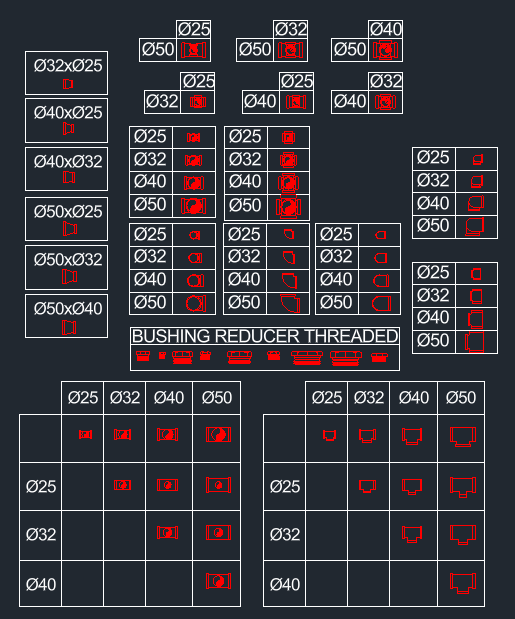
Looking for fire fighting threaded fittings CAD blocks you can drop straight into a sprinkler layout? This free download gives you a complete DWG library of threaded fittings in plan and elevation. It includes equal and reducing tees, reducing couplings, elbows, and a dynamic bushing reducer block that covers 19 size combinations from 20 mm to 100 mm in a single insert.
Threaded fittings appear at almost every sprinkler drop, reducer and change of direction on small-bore piping. If you use a ready, consistent symbol set, you save drafting time and your shop drawings look clean and uniform from sheet to sheet.
What Is Included in the Fire Fighting Threaded Fittings DWG
The drawing is organised into labelled size tables. You can pick the correct block by size without guessing.
Equal and Reducing Tees (Plan and Elevation)
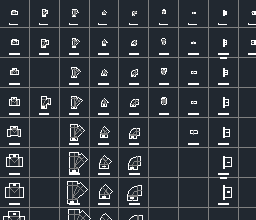
There are two full tee matrices, one for plan view and one for elevation. Each matrix covers run sizes Ø25, Ø32, Ø40 and Ø50 against branch sizes Ø25, Ø32 and Ø40. It gives you 4 equal tees and 6 reducing tees per view, so 20 tee blocks in total. Every valid run/branch combination in the 25–50 mm range is covered.
Reducing Tees with Outlet Symbol
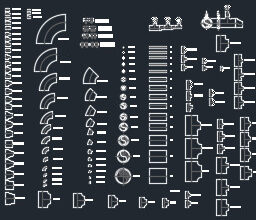
A separate set shows the reducing tee with the branch outlet drawn as a circle, as it appears when the branch rises or drops. The set covers 50×25, 50×32, 50×40, 32×25, 40×25 and 40×32.
Reducing Couplings
There are six concentric reducing coupling blocks: Ø32×25, Ø40×25, Ø40×32, Ø50×25, Ø50×32 and Ø50×40. You will use these wherever branch lines step down along their length.
Equal Tees and Elbows by Size
Size tables for Ø25, Ø32, Ø40 and Ø50 hold equal tee and elbow blocks in several view orientations. You can place a fitting that matches the viewing direction of your layout.
Dynamic Bushing Reducer Block (19 Sizes)
This block makes the file different from most free sprinkler fittings libraries. Instead of 19 separate bushing blocks, there is one dynamic block with a lookup grip. You click the grip and choose the size, and the geometry updates. Available sizes:
| Male (larger) size | Female (smaller) sizes available |
|---|---|
| 20 mm (¾”) | 15 |
| 25 mm (1″) | 15, 20 |
| 32 mm (1¼”) | 15, 20, 25 |
| 40 mm (1½”) | 15, 20, 25, 32 |
| 50 mm (2″) | 15, 20, 25, 32, 40 |
| 65 mm (2½”) | 50 |
| 80 mm (3″) | 50 |
| 100 mm (4″) | 50, 80 |
The 25×15 and 25×20 states cover the most common sprinkler drop connections. In these, a 1″ branch reduces to the ½” or ¾” sprinkler outlet or armover.
Fire Fighting Threaded Fittings CAD Blocks Free Download
The DWG is free for personal and commercial projects. Click the button below, wait for the short countdown, and the file will download directly.
Checking…
Where Threaded Fittings Are Used in Sprinkler Systems
On most projects, a common rule of thumb applies. Piping up to 50 mm (2″) is threaded, and 65 mm and above is grooved or welded. Threaded joints are typically used on:
- Sprinkler branch lines and armovers
- Drops and sprigs to pendent, upright and sidewall sprinklers
- Small cross mains in light hazard occupancies
- Drain, test and inspector’s test connections
- Gauge and trim piping on alarm valves and zone control assemblies
The 65–100 mm bushing sizes are included for the threaded connections that still appear at larger sizes. Examples are trim takeoffs, drain valve connections and equipment tappings.
Code Requirements for Threaded Sprinkler Piping
NFPA 13 (2022 Edition)
NFPA 13 sets a minimum wall thickness for threaded steel pipe. Pipe smaller than 8″ must be at least Schedule 40, and 8″ and larger at least Schedule 30. The reason is that cutting threads removes wall material. For this reason, Schedule 10 pipe is used with roll-grooved joints and is not threaded. Wherever threaded fittings are shown, state the pipe schedule clearly in your drawing notes.
Sprinkler system components, including fittings, must be rated for at least 175 psi (12.1 bar) working pressure. Where system pressure exceeds this, confirm the fitting class with the manufacturer’s data sheet.
Threaded Fitting and Thread Standards
- ASME B16.3: Malleable iron threaded fittings, Class 150 and 300
- BS EN 10242: Malleable cast iron threaded fittings
- ASME B1.20.1: NPT (tapered) pipe threads
- ISO 7-1: BSPT (tapered) pipe threads
NPT and BSPT threads look similar but are not interchangeable. The thread angle is different, and at most sizes the pitch is also different. Many UL/FM listed sprinklers and valves come with NPT threads, while fittings in some markets are supplied with BSPT threads. Specify one thread standard in your general notes and material submittal to avoid leaks on site.
Bushing vs Reducing Coupling: Which One to Draw?
Both reduce pipe size, but NFPA 13 treats them differently. It prefers one-piece reducing fittings, such as reducing tees, couplings and elbows, for size changes. It permits hexagonal or face bushings only in specific cases. The most common case is reducing a fitting outlet to the sprinkler connection.
- Use a reducing coupling or reducing tee for size changes along branch lines and mains.
- Use the bushing block only where the project specification and the NFPA 13 edition in force allow it. This is typically at sprinkler outlets.
If you draw the correct fitting from the start, you avoid review comments from the consultant or the authority having jurisdiction.
Drafting Tips for These CAD Blocks
- Blocks are drawn in millimetres. Insert them at scale 1 in an mm-based drawing.
- Size labels follow nominal diameter (Ø25 = DN25 = 1″). If your project uses inch sizes, add them in your pipe tags.
- Use the plan matrix for ceiling layouts, and the elevation matrix for riser diagrams and sections.
- For bushings, copy one instance and switch sizes with the lookup grip instead of inserting a new block each time.
- Count fittings with the BCOUNT command or Data Extraction to speed up your BOQ take-off.
Frequently Asked Questions
Are these fire fighting threaded fittings CAD blocks really free to download?
Yes. The DWG is a free download, and you can use the blocks on shop drawings, tender drawings and as-built drawings for commercial projects.
Which AutoCAD version do I need to open the file?
The file opens in AutoCAD 2018 and all later versions, as well as in compatible CAD software that supports the DWG 2018 format.
What sizes does the bushing reducer CAD block cover?
The dynamic bushing block has 19 sizes: 20×15, 25×15, 25×20, 32×15 to 32×25, 40×15 to 40×32, 50×15 to 50×40, 65×50, 80×50, 100×50 and 100×80 mm.
Can Schedule 10 pipe be threaded for sprinkler systems?
No. NFPA 13 requires threaded steel pipe smaller than 8″ to be at least Schedule 40, because threading reduces the wall thickness. Schedule 10 is used with roll-grooved joints.
Are NPT and BSPT threaded fittings interchangeable?
No. The two thread forms have different thread angles, and at most sizes different pitches as well. Mixing them causes leaks. Specify one thread standard for the whole system.
Up to what size are threaded fittings used in fire sprinkler piping?
Threaded joints are commonly used up to 50 mm (2″), and grooved or welded joints from 65 mm upward. NFPA 13 does not set this limit itself. It comes from project specifications and installation economics.